
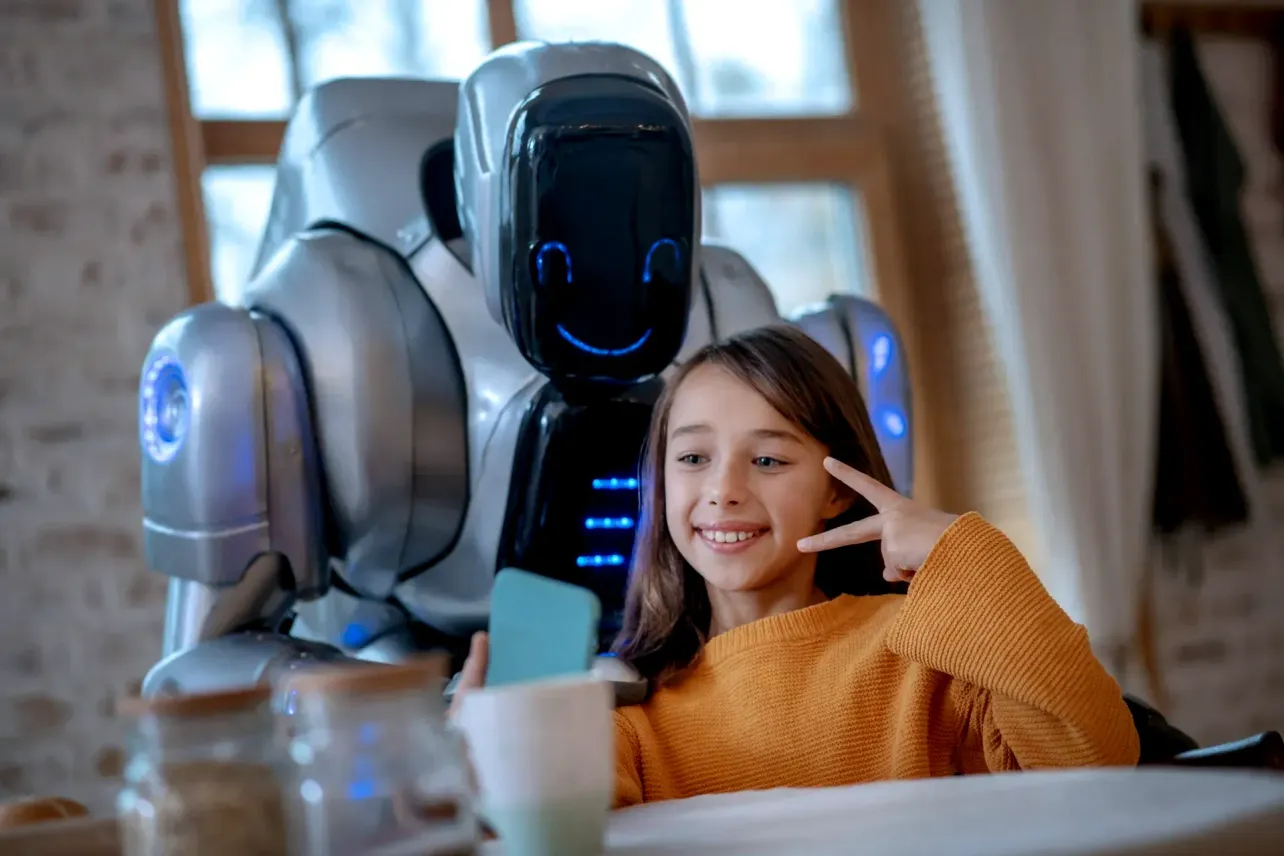
I have three small children and, if I am honest, this question sits in my head more often than I would like. Us parents care a lot about our little ones, and we especially care about preparing them for the world ahead as best as we can. We spend hours of time and significant resources trying to ensure they have success, fulfilment, happiness, and a level of comfort and security in later life. If you're a mum or dad, you'll know the grind well. Even if you're not, I'm sure you still get it.

Your employees know the truth. Does your EVP? At Fathom we measure the "Credibility Gap" between your promise and their reality.
Most of us parents grew up with a fairly familiar social contract in mind: work hard at school, get the grades, build credentials, enter a profession, piece together some stability from there. It wasn't foolproof but it was recognisable. You could at least tell yourself you knew what you were aiming at and what you needed to do.
Will that path continue to exist if AI advancements go they way many tout them to? Plenty of people will still follow it today but it doesn't feel as solid as it once did? For a lot of us with skin in the game, the future of work is starting to look... quite different. Obviously, AI has not made education irrelevant, and it has not made effort obsolete.... yet. But it is knocking my confidence in the old formula - and maybe yours, too. In fact, I think it has forced a lot of us parents to look at the future and wonder whether we are still preparing our children for the world we entered, rather than something that plays by a different set of rules.
The more I look around and speak to others the more widespread I can see this parental anxiety is, and understandably so.
The old promise is weakening
For decades, the broad promise was simple enough that whole societies were built around it. Education was the route up. Credentials were a form of currency and security. Professions carried status, direction, and a reasonably clear identity. A parents job was always clear, if not simple, help your kids navigate the education system successfully. Do this and you'd feel you were doing well and your kids would have a solid chance of professional and societal success - the rest was on them.
Sadly, this well trodden path has been fraying for years for reasons that have nothing to do with AI alone: housing costs, wage pressure, debt, insecurity, a general sense that the middle-class script has become harder to trust. And now we have AI, which has created a growing sense that some of the very tasks schools and employers have traditionally rewarded - writing polished material, being creative, processing information, having knowledge and expertise in your chosen field - are becoming cheaper and easier to come by or automate. The World Economic Forum’s Future of Jobs Report 2025 says that, on average, 39% of workers’ core skills are expected to change by 2030. The same report still ranks analytical thinking as the top core skill, but also places resilience, flexibility, leadership, social influence, creative thinking and curiosity high on employers’ lists. But I doubt the answer is a simple switch from hard skills to soft skills.
This all matters, though, because once quality output becomes easier to generate, the old link between education, visible intelligence or expertise, and economic advantage starts to dissolve. The market isn't necessarily moving away from human intelligence, but it certainly feels like it'll need a lot less of it in the future. And the parts it does need humans for seems to be changing significantly.
Leaving parents like me scratching our heads and wondering what to do.
Why parents feel uneasy, even if they cannot quite explain why
I think these unanswered questions, and this moment in time, are why so many of us parents feel unsettled right now. The old path feels like it's narrowing and the rewards for our children's academic achievements are far less certain than before. And, as professionally curious as I may be around grand theories about technological disruption, it's the more practical questions that matter most right now... what should I encourage my kids to do or get good at? What should I worry less about? What do I keep from the old model, and what needs updating?
I'm trying my hardest not to rush into melodrama. But, with my kids' futures seemingly at steak, that's not always easy. The fact that 25-45% (depending on your source) of graduate roles have been wiped out in the UK since the launch of Chat GPT doesn't necessarily mean that education no longer matters, or that knowledge is yesterday’s concern, or that children no longer need discipline, attention and strong foundations. But I'd say it's enough to get even the coolest of parents somewhat concerned.
There are small rays of hope and counter arguments. One of the clearest things about this moment is that weak thinkers often use AI badly. They accept confident slop as if it's gospel. They cannot tell when an argument is thin. They do not know enough to challenge the answer in front of them. UNESCO’s guidance on generative AI in education makes a similar point in more institutional language, stressing that systems need human-centred guardrails and that learners need the capacity to evaluate and use these tools responsibly. Hilariously, Microsoft recently came out saying that Copilot is there "for entertainment purposes" and isn't to be trusted with serious tasks.

Helping HR, talent acquisition, employer branding, and company culture professionals find careers worth smiling about.
So the old basics still matter. Reading well matters. Writing clearly matters. Handling numbers matters. Building concentration matters. Tolerating difficulty matters. What feels less certain is whether those basics, on their own, still buy what many parents thought they bought into. And what exactly are the careers that will be left? Will there be enough of them to go around?
And how exactly do we prepare our babies for a world none of us can fully picture yet?
What the evidence says children may need more of now
FWIW, the best contemporary guidance seems to point in a fairly consistent direction. UNESCO’s AI Competency Framework for Students says education systems should prepare students to be responsible and creative citizens in the age of AI. It highlights critical judgement of AI outputs, awareness of citizenship responsibilities, foundational AI knowledge for lifelong learning, and inclusive, sustainable design. In other words, the goal is not simply to teach children how to use the tools. The goal is to help them understand these systems, question them, use them thoughtfully and avoid becoming dependent on them. But whether all this creativity and good citizenship will help them find secure well-paying jobs, or not, is where I'm still unconvinced.
The OECD is moving in a similar direction. Its PISA 2025 “Learning in the Digital World” work is designed to assess students’ ability to build knowledge and solve problems using computational tools, with a focus on self-regulated learning and computational inquiry practices. The language is dry, but the implication is not. Education systems increasingly recognise that children need more than correct answers. They need to be able to manage their own learning, navigate digital environments, explore unfamiliar problems and make sense of the technology while using it. OECD says too little attention has been given to the skills and attitudes students need to become active and autonomous users of technology for real-world, open-ended problems.
Taken together, that points towards a few priorities that seem increasingly hard to argue with. Strong foundations still matter, but so do judgement, self-direction, communication, adaptability and a realistic understanding of what AI can and cannot do (goalposts that seem to be shifting daily). Children need to know how to use these systems, but also, critically, how ands when to question them. They need to be able to work with technology without quietly outsourcing themselves to it. Somewhere, among all this, a new set of modern parenting principles start to emerge.
What parents should probably be doing
This is the part every parent wants to get their head around, making it what matters most in my opinion. Sadly, it seems as if there is still no clear cut approach or foolproof way through this uncertainty. Parenting, as it turns out, will always be fraught with a mixture of hope and anxiety. So, no change there. But I dare say the general direction of new advice is somewhat clearer than it was a year or two ago.
The first point is not to panic and throw out the old virtues. Us humans have ridden out enough apocalyptic tech revolutions to know that much. Although, I find it helps to keep reminding myself of this. Where our kids are concerned, effort, knowledge, and focus still matter. If anything, the abundance of machine-generated answers makes human depth and expertise more valuable, not less. Children still need to learn how to read properly, write properly, argue properly and persist when things are difficult - perhaps more so now than ever before.
 EBN
EBN
I think that the target around those virtues is what's shifting. The goal is no longer to simply help children outperform others at producing neat, school-approved output. Rote learning still has a place, but probably less so. It's now up to us to help our young ones build the judgement they need to know when an answer is good, when it is thin, when it is misleading, when it is ethically dubious, and when they need to go beyond it or scratch underneath it. This is the new parenting game we need to figure out.
This probably means making more room for real discussion, open-ended projects, spoken communication, debate, problem-framing and the kind of tasks where children have to explain not just what they think, but how they got there. It also means helping them build some emotional resilience. A world of constant technological change is unlikely to feel calm or stable. Children will need some tolerance for uncertainty, frustration and the experience of not always having a neat or binary answer straight away.
Simply put I think it's this: parents should probably be trying to raise children who can use AI, question AI, and still think beyond AI. And especially the think beyond it part.
Schools are moving, but not fast enough
Us parents cannot solve this alone, and we shouldn't be expected to. Schools are clearly trying to pivot but they are also lagging behind - and I'm sure many of us parents feel this. UNESCO brings some authority to these feelings and says many educational institutions remain underprepared to validate generative AI tools and build the human capacity needed to use them well. At the same time, the very fact that PISA 2025 is assessing self-regulated learning and problem-solving with computational tools shows that mainstream education bodies know the old model of success is no longer enough.
The system is moving, but too slowly, unevenly, and with a lot of confusion. Assessment is still often tied to polished output. Teacher preparation is inconsistent. Policy is patchy. And plenty of schools are still somewhere between curiosity and panic. Again, this is something that feels all too familiar to too many of us parents. Being asked to prepare children for a future that institutions are still only half prepared to describe is a big part of where a lot of our anxiety comes from.
Employers have skin in this too
There is a slightly reassuring point here. The advice emerging from employers is not wildly different from the advice emerging from education researchers. It is just phrased in the language of hiring rather than child development.
The World Economic Forum points to analytical thinking, resilience, creativity and social influence. Deloitte’s 2025 Gen Z and Millennial Survey found that 74% of Gen Z and 77% of millennials believe generative AI will affect the way they work within the next year, and more than eight in 10 say soft skills such as empathy and leadership are becoming more important for career progression. Microsoft’s 2025 Work Trend Index, drawing on survey data from 31,000 workers across 31 countries along with labour and productivity data, argues that work is being reorganised around a new relationship between human judgement and machine capability.
Different organisations use different language, but the gist is similar. The future seems to reward a blend of technical fluency, judgement, adaptability and recognisably human strengths.
That should give employers something to think about as well. If schools are still geared towards polished output, and if parents are still trying to decode what matters most, businesses cannot simply sit back and complain that the next generation is underprepared. They will have to get much clearer about what they actually value, and much better at assessing it. A graduate who can turn out tidy work with AI assistance may be useful, but that won't stand out much going forwards. Employers will need people who can think in context, communicate well, ask better questions, collaborate with others and use technology without surrendering judgement to it. In some pockets, I dare say this could already be starting - the WEF reports that 85% of employers plan to prioritise upskilling, 70% expect to hire staff with new skills, and half plan to reorient their business in response to AI.
There is, of course, an employer branding angle here too. For years, many organisations have been selling some fairly generic promises to parents, students and young workers: work hard, get in, build a career. That promise now needs more substance. What kind of human potential does the company actually value? If any at all. Does the company reward curiosity or just compliance? Communication or just polish? Independent judgement or just low-risk competence? And it's not enough for employers to simply ask for stuff, they need to demonstrate where and how these people fit. If parents are increasingly anxious that the old professional paths no longer works as well as they once did, employers share the responsibility in making the next map more legible.
So what should parents hold onto?
I keep coming back to the fact that most parents do not want a manifesto. They want a few honest bearings. Mine are still forming, but they are probably something like this...
Keep the basics. Protect reading, writing, numeracy, focus and general knowledge. Make room for open-ended thinking and real discussion, so that children get practice in forming views, not just retrieving answers. Avoid junk learning through platforms like social media. Encourage communication in the broad sense - spoken, written, social, interpersonal - because a lot of future value will sit there. Direct communication with other humans has never been more important - I make a point of asking my kids to speak with strangers as much as possible (such as asking for water in restaurants).
We need to help our kids build tolerance for uncertainty and frustration. A fast-changing world is not kind to people who need every path clearly laid out - and the better equipped they are to deal with it the further they'll go. And talk to them about AI and digital technologies early enough and often enough that it becomes a tool they can understand and question, rather than a hack they outsource everything to.
The truth, I think, is that I wrote this because I, like a lot of us, feel slightly unmoored. We've always lived with a reasonably coherent story about education and work, but now we can feel it loosening under our feet. The old social contract has not vanished entirely. Good schools still matter. Qualifications still matter. Experts and professions still matter. But the confidence that those things alone will get someone through has eroded a lot.
So, are we raising our children for the wrong future? Maybe the honest answer is that many of us are at risk of doing exactly that if we cling too tightly to the old script. But I do not think the answer is panic, gimmicks, or trying to turn every child into an AI prodigy by the age of nine. The better answer, at least from where I sit as a father trying to think this through, is to raise children with strong foundations and enough flexibility of mind to keep adapting. Children who can think, speak, question, learn, recover, and stay human in a world that will increasingly test all of those things.
Sources
Takeaways
1. The old education-to-career path is no longer enough
Parents can no longer assume that good grades and qualifications alone will guarantee long-term security in an AI-shaped economy.
2. AI is changing what children need to succeed
As AI takes on more routine cognitive work, children may need stronger judgement, adaptability, communication and resilience alongside academic foundations.
3. Parents need to raise children who can think beyond AI
The goal is not to compete with machines on routine tasks, but to help children use AI wisely without outsourcing their own thinking.
4. Schools are being forced to rethink what success looks like
Education systems are starting to shift, but many still reward polished output more than critical thinking, self-direction and real-world problem-solving.
5. Employers need to redefine future-ready talent
Businesses may need to look beyond credentials and assess the human strengths AI cannot easily replace, including judgement, collaboration and communication.
 EBN
EBN