


LVMH unveiled its employer brand campaign on 25 July 2025, rebuilt its “Work at LVMH” experience, and wrapped both in a single promise: “Where Dreams Become Careers.” (lvmh.com)
It is a big move for a group whose talent story has often lived inside individual Maisons, with recruitment identity split across Louis Vuitton, Dior, Sephora and dozens more. LVMH’s new line attempts something more central: sell the advantage of the ecosystem itself, then let the brands do the rest.

Your employees know the truth. Does your EVP? At Fathom we measure the "Credibility Gap" between your promise and their reality.
This article takes a methodical look at what LVMH is really promising, how it is proving it, where the message is strong, and where the employee commentary complicates the picture. We also benchmark LVMH against its closest luxury rivals using publicly available Glassdoor category ratings.
What LVMH launched, in plain terms
Unveiled on 25 July 2025, LVMH’s campaign frames the group as a “unique career playground” and positions its breadth across luxury categories as a competitive advantage for attracting, developing and retaining talent.
The campaign’s mechanics are classic employer brand: real employee stories, a consistent line, and a rollout plan across regions and paid and organic media. LVMH says the campaign showcases the journeys of 12 employees and will roll out in phases starting September 30, initially in France, Italy and the US, followed by China and Southeast Asia and Oceania.
The careers site refresh mirrors the same logic. “Work at LVMH” now opens with the EVP line and a gallery of 22 individual journeys across locations, functions and sectors.
The headline story LVMH wants you to retain is simple: dreams are personal, careers are built through movement, and the ecosystem makes that movement possible.
Why change: the strategic logic behind the rebrand
LVMH is explicit about the “why”. It argues that being present across all major luxury sectors creates a talent advantage, and it ties the employer brand directly to the group’s wider mission, “The Art of Crafting Dreams.”
There are also two practical, recruitment-shaped reasons this repositioning makes sense:
- Scale forces clarity. LVMH says it hires close to 60,000 new talents each year, across a wide spread of roles and geographies. At that volume, “each Maison does its own thing” becomes expensive and inconsistent.
- Mobility is the differentiator. The employer brand leans hard on development, training and internal movement, supported by group-level metrics.
Luxury trade press also picked up the campaign as a signal that talent attraction is being treated as a brand problem, not just a hiring one. (Luxury Daily)
 EBN
EBN
The EVP, inferred using a three-pillar structure
Below is an EVP “read” based on LVMH’s campaign language, careers site architecture, and the proof points the group chooses to foreground.
EVP tagline
Where Dreams Become Careers (lvmh.com)
Pillar 1: A career playground with real range
Promise: You can build a career by moving across Maisons, functions, sectors and countries, without leaving the group.
Proof LVMH uses:
- “Over 75 Maisons” across six sectors, with operations in roughly 80 countries and 500+ métiers. (lvmh.com)
- Stories positioned specifically as cross-functional and cross-geo examples, from operations and retail to finance and HR. (lvmh.com)
- Internal mobility metrics, presented as a core HR capability (not a perk). (lvmh.com)
What’s smart here: Many global employers claim “opportunity”. LVMH is trying to make “opportunity” concrete by anchoring it in structure (ecosystem breadth) and a behaviour (mobility).
Pillar 2: Craft tomorrow’s luxury, with purpose and standards
Promise: You get to shape the future of luxury, with excellence as the baseline and sustainability, inclusion and culture as part of the brief.
Proof LVMH uses:
- “Dream Far” explicitly frames future luxury as more respectful of the environment and people, and calls out equal opportunity and inclusion. (lvmh.com)
- The group mission sets out values that translate neatly into employer brand language: creativity and innovation, excellence, entrepreneurial spirit, and positive impact. (lvmh.com)
- The campaign itself is aligned to the corporate mission, explicitly connecting “careers” to “crafting dreams”. (lvmh.com)
What’s smart here: This is “luxury” without apologising for luxury. It keeps desirability, then adds legitimacy through impact and standards.
Pillar 3: Develop fast, learn continuously
Promise: Your growth is engineered through training, programmes and visible progression paths.
Proof LVMH uses:
- LVMH says 78% of permanent employees received training in 2023 and 18,000 benefited from internal mobility. (lvmh.com)
- A later LVMH story reports 82% receiving professional training in 2024 and 19,000 benefiting from internal mobility opportunities. (lvmh.com)
- “Always Dream” frames people as central to performance and highlights the scale of the workforce behind the products. (lvmh.com)
What’s smart here: LVMH is selling development as a system. That is a stronger claim than “we invest in people”, and it gives candidates something to test during interviews.

Helping HR, talent acquisition, employer branding, and company culture professionals find careers worth smiling about.
The creative choice: why “dreams” is doing heavy lifting
“Dreams” is not a random word in luxury. LVMH’s mission explicitly uses “crafting dreams” as a framing device for the whole group, and the employer brand borrows that equity rather than inventing a separate HR slogan. (lvmh.com)
But “dreams” also does a practical job in employer branding:
- It stretches across very different jobs, from retail to operations to corporate roles, without sounding like it belongs to only one function. (lvmh.com)
- It creates permission for multiple career narratives. The careers site leans into that by showcasing different “journeys” rather than one idealised ladder. (lvmh.com)
- It avoids a common multi-brand group problem: sounding like a holding company.
There is, however, a risk embedded in any aspirational EVP: if the day-to-day experience feels less “dream” and more “targets”, employees will write the counter-campaign for you, one review at a time.
Which brings us to the employee commentary.
What employees say: Glassdoor pros and cons
LVMH’s Glassdoor headline ratings suggest a generally positive, but not universally glowing, experience:
- Overall rating 3.9/5
- 69% would recommend to a friend
- 87% CEO approval
Common “pros” themes
Based on the “Users say” snippets and recent review excerpts:
- Benefits and allowances get repeated mentions.
- Colleagues and teams are frequently cited as a bright spot.
- Promotion or progression appears in some reviews, particularly in retail contexts.
Common “cons” themes
Again, using Glassdoor’s surfaced themes and excerpts:
- Pay pressure: “low salary” and “pay is low for the number of hours” show up in the “Users say” summaries.
- Workload and work-life balance: long hours, overload, and weak work-life balance recur.
- Management quality and clarity: reviews cite poor management, shifting direction, and internal dynamics affecting decisions.
- Rigid on-site expectations appear in at least one recent review excerpt.
A quick “promise vs reality” read
- LVMH’s EVP is strongest when it talks about ecosystem range and career movement. That is both believable and measurable.
- The friction shows up around work-life balance (3.4) and career opportunities (3.5), which are exactly the areas an aspirational career promise tends to stress-test. (Glassdoor)
This does not mean the EVP is “bad”. It means the EVP is ambitious, and ambition needs honesty around trade-offs. The most reliable way to handle those trade-offs is to ground the EVP in primary research, then write to what the data can support.
Momentum isn’t progress. Especially when you always end up back where you started. Fathom helps you escape the loop. With insight, not intuition. Fathom helps companies build employer brands worth believing in and sticking with.
Competitor landscape: how LVMH compares on Glassdoor (snapshot)
Using publicly displayed Glassdoor aggregates, here is the high-level picture:
- Richemont leads this peer set on overall rating at 4.1, with strong category scores across the board. (Glassdoor)
- Hermès sits at 4.0, with particularly strong “Culture and values” (4.1). (Glassdoor)
- LVMH is at 3.9, generally solid, with its lowest category score in work-life balance (3.4). (Glassdoor)
- Chanel is at 3.8. (Glassdoor)
- Kering is at 3.7, with “Career opportunities” (2.9) and “Senior management” (3.0) the weakest categories shown. (Glassdoor)
- Prada trails at 3.2 overall, with work-life balance and senior management both at 2.7. (Glassdoor)
Interpretation (labelled): LVMH’s positioning as a “career playground” makes strategic sense in this field. Hermès and Richemont score higher on “feel” categories, but LVMH is trying to win on the breadth-and-mobility narrative that only a true ecosystem can credibly sell.
Luxury employer reputation benchmark: LVMH vs peers (Glassdoor)
This benchmark uses publicly visible Glassdoor aggregates (as of 30th Jan 2026) to show how LVMH’s employer reputation compares with close luxury peers across overall rating, category scores, and two headline sentiment signals (recommendation and CEO approval). It is not a diagnostic on its own, but it is a useful external mirror for stress-testing EVP claims, identifying likely friction points, and prioritising what to validate through primary research.
Luxury employer ratings comparison (Glassdoor)
| Company | Score | Visual | Overall | Recommend | CEO |
|---|---|---|---|---|---|
| Richemont | 4.1 | 4.1 | 84% | 89% | |
| Hermès | 4.0 | 4.0 | 78% | 91% | |
| LVMH | 3.9 | 3.9 | 69% | 87% | |
| Chanel | 3.8 | 3.8 | 74% | 81% | |
| Kering | 3.7 | 3.7 | 63% | 66% | |
| Prada | 3.2 | 3.2 | 53% | 58% |
LVMH Glassdoor Insights
- LVMH is in the top tier, but not setting the pace: On overall score, LVMH sits behind Richemont and Hermès, and ahead of Kering and Prada. For employer brand teams, that is a “credible, competitive” position, with clear headroom to differentiate if the experience can be tightened in a few categories.
- The lowest-scoring categories are where the EVP will be audited: LVMH’s weaker areas (work-life balance, career opportunities, senior management) are not just HR problems. They are the categories most likely to create an external credibility gap when the EVP promises big careers and growth. If the campaign is built around aspiration, these become the proof points leaders should measure, segment, and improve.
- CEO approval looks strong across luxury, so it is hygiene, not differentiation: High CEO approval appears common across this peer set. That suggests reputation advantage will come less from “belief in the top” and more from day-to-day management quality, mobility access, and workload realities.
- The category pattern hints at different “talent stories” in the sector: Hermès and Richemont tend to score higher on experience categories (culture, benefits, balance). LVMH’s employer brand strategy leans into a different advantage: breadth and mobility across a large ecosystem. That is a smart narrative choice, but it requires evidence that mobility is accessible at scale, not only to a narrow group.
- Where this data helps employer branding most: Treat these scores as a prioritisation tool for three things:
- Message discipline: which claims need tighter qualifiers or clearer proof.
- Content strategy: which themes deserve more “show the work” storytelling (mobility pathways, manager quality, realistic workload norms).
- Research agenda: which gaps to validate with primary research, so pillars are anchored in measurable truth rather than wishful positioning.
- The strategic takeaway: Ambitious EVPs can be a growth lever, but they raise the bar for evidence. The winners in this category tend to pair aspiration with disciplined proof, and then invest in the operational fixes that reduce the gap between the campaign and the lived experience.
If you find this EVP deep dive useful, jump here to check out: Anduril: “Don’t work here” the employer brand that dares you to look twice
 James Robbins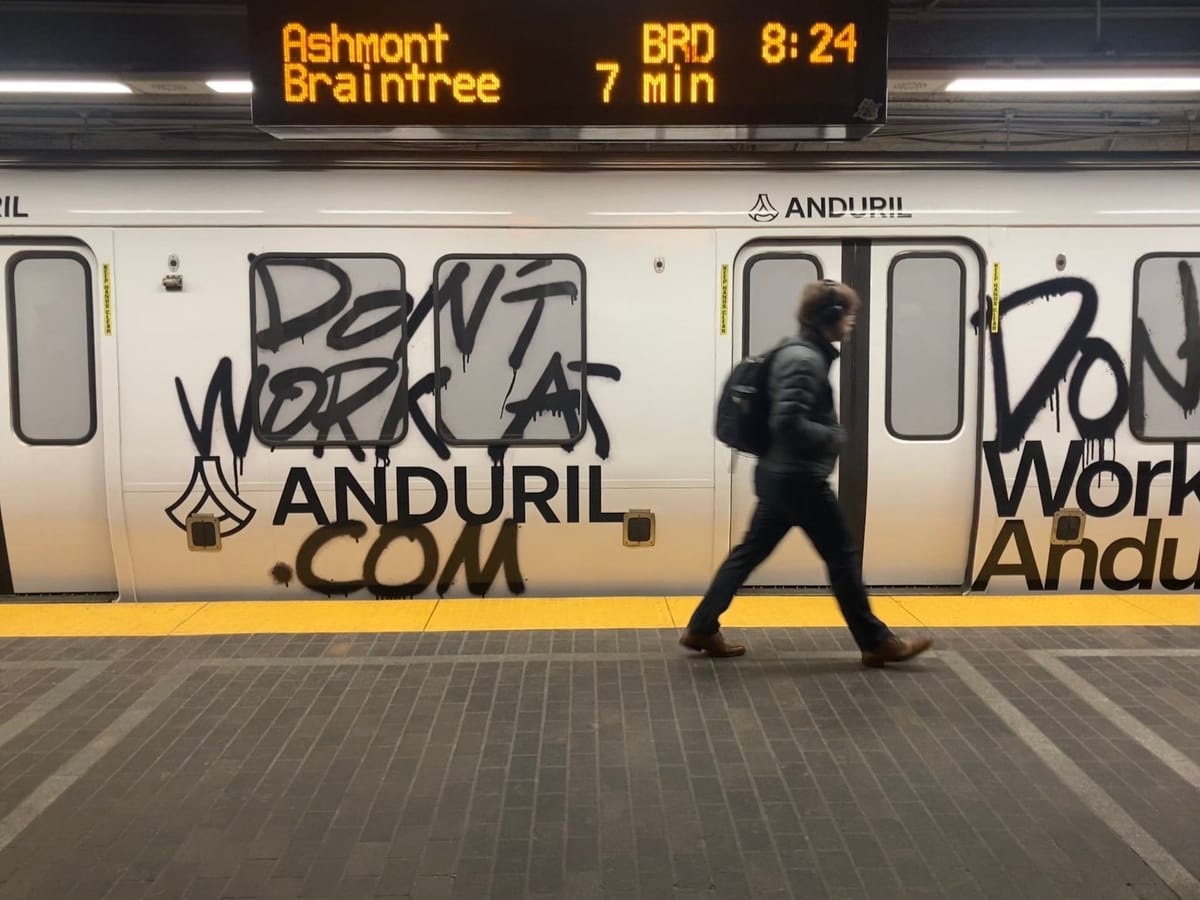
Is the LVMH employer brand any good?
Where it works
- It is specific about the true differentiator. LVMH keeps returning to ecosystem advantage and mobility, and backs it with scale and internal movement stats.
- It avoids a holding-company vibe. By tying directly to the group mission, the line has narrative consistency across corporate, brand, and talent messaging. (lvmh.com)
- It shows, then tells. The careers site leans into actual journeys across cities and functions, instead of a single “ideal candidate” archetype. (lvmh.com)
Where it could wobble (and how candidates will test it)
- Work-life balance is the obvious pressure point. Glassdoor’s work-life category sits at 3.4, and “no work life balance” appears in the surfaced “cons” themes. Candidates will probe this fast in interviews. (Glassdoor)
- Career opportunity needs transparency, not poetry. “Career playground” is a strong metaphor. It will land better when paired with practical visibility: internal hiring norms, mobility eligibility, and what progression looks like in retail versus corporate roles. The reviews include both “room for promotion” and “not much development opportunities given”, which is exactly the sort of mixed signal that benefits from clarity. (Glassdoor)
- Management consistency is harder to brand around. “Poor management” and “no clear direction” showing up in “cons” is not unusual for large groups, but it is a reputational drag on any promise about growth. (Glassdoor)
LVMH’s employer brand is doing what it should: making a complex organisation legible, and turning scale into a candidate-facing advantage. The execution will be judged on whether mobility and development feel accessible to more than a small, well-networked slice of the workforce.
 EBN
EBN
What other employer brand teams can learn from this launch
- Build the EVP around what only you can offer. LVMH is leaning into a structural advantage (ecosystem breadth), not a generic cultural claim.
- Do not let ambition outrun evidence. Aspirational EVPs create heat fast, but they also raise the risk of a “credibility gap” if the lived experience does not match the line. The fix is not better copy, it is primary research that quantifies what different talent segments actually value, where your reputation is strong or weak versus competitors, and which trade-offs employees will warn candidates about. That data is what turns EVP pillars into defensible claims, and it is what keeps “dreams” from turning into eye-rolls.
- Tie your EVP to an existing corporate narrative. “Dreams” works because it is already a corporate mission frame. (lvmh.com)
- Publish proof points candidates can verify. Training coverage and mobility counts are rare in employer brand comms. They also invite scrutiny, which is healthy.
LVMH’s advantage is real: few employers can offer this breadth of brands, roles and geographies under one roof. The question is whether enough people can access that advantage, consistently, across Maisons and markets. If LVMH can evidence mobility and development at scale, and tackle the predictable pressure points around workload and management, this EVP could move from a compelling story to a durable talent edge.
Takeaways
What is LVMH’s employer brand tagline?
“Where Dreams Become Careers.” (lvmh.com)
How many employees does LVMH cite in its employer brand materials?
The campaign story references ambitions aligned to roughly 213,000 employees (2023 framing) and the careers content references around 211,000, reflecting different snapshots across pages. (lvmh.com)
What does LVMH claim as its differentiator?
Being present across all major luxury sectors, enabling internal career movement across Maisons, roles and countries. (lvmh.com)
What is LVMH’s Glassdoor rating?
3.9/5 overall, with 69% recommending and 87% CEO approval on the UK Glassdoor listing viewed. (Glassdoor)
Data sources and references
LVMH (primary)
- LVMH press release announcing the employer brand campaign, including rollout plan and talent metrics. (lvmh.com)
- LVMH “Work at LVMH” careers hub and “Where Dreams Become Careers” journeys. (lvmh.com)
- “Dream” subpages used to infer pillar themes (Dream Big, Dream Far, Dream Everywhere, Always Dream). (lvmh.com)
- LVMH mission page describing “The Art of Crafting Dreams” and the group’s values. (lvmh.com)
- LVMH “Meeting our talents in Asia” story with updated training and mobility figures. (lvmh.com)
Employee voice and competitor benchmarks (Glassdoor, UK pages viewed)
- LVMH Glassdoor overview and review excerpts used for pros and cons themes. (Glassdoor)
- Hermès Glassdoor overview. (Glassdoor)
- Kering Glassdoor overview. (Glassdoor)
- Richemont Glassdoor overview. (Glassdoor)
- Chanel Glassdoor overview. (Glassdoor)
- Prada Glassdoor overview. (Glassdoor)
Secondary coverage
- Luxury trade and business coverage referencing the campaign launch. (Luxury Daily)
 Fathom