

Key points
- Robots are already reducing hiring in warehouses, logistics and driving, mostly through vacancies that never get posted.
- Humanoids aren't the first wave, but shipments are forecast to grow from about 15,000 in 2025 to hundreds of thousands a year by 2030.
- Repetitive physical work in predictable settings goes first. Skilled trades and care work hold out longest.
- Robots hit the lowest-paid first: in the US, robot-exposed roles pay roughly 40% less than roles exposed to AI agents.
- At scale, one robot could do nearly three people's work for a fraction of the hourly cost, while paying no income tax or social contributions.
- The biggest employer brand risk lies in how robots are introduced, explained and paid for.
We've all seen the videos across LinkedIn and YouTube. Robots folding laundry, sorting parcels and stacking shelves with an unnervingly human sway. The poster always says something about the future of work and, I'm afraid to say, it looks like they now have a point.
We've spent two years at EBN picking over what Agentic AI is doing to white-collar work. The physical side of the story has been easy to wave away as quirky science fiction... until now. Robots are already doing work that people were once paid to do, that's not especially new, but what's now coming up fast is a whole other ball game.
We can all see it coming. Is it time to get serious about what it means?

Employer branding works better when people share what they know. EBClub brings practitioners together to exchange ideas, compare experiences, and learn from the people doing the work.
Already on the payroll
Robots are hardly new to the workplace. The International Federation of Robotics counted a record 5 million industrial robots in operation at the end of 2025, after more than 600,000 new installations in the year. Density is highest where labour is scarcest: South Korea runs 1,220 robots per 10,000 manufacturing workers, Singapore 818, Germany 449 and the US 307, against a global average of 132 (IFR).
What has changed is how far beyond the factory they now reach. Amazon deployed its millionth robot in mid-2025, against roughly 1.56 million employees (FreightWaves). Packages shipped per employee rose from 175 to nearly 3,870 in a decade, and average headcount per facility fell to about 670, the lowest in at least 16 years (GeekWire, citing the WSJ). Internal documents reported by the New York Times describe Amazon automating up to 75% of operations and avoiding more than 600,000 US hires by 2033, with around 160,000 of those by 2027 (HRD).
Note the wording - hires avoided. That is how most of this will play out: no mass redundancy announcement, no robot-shaped P45, just a significant curtailing of future vacancies.
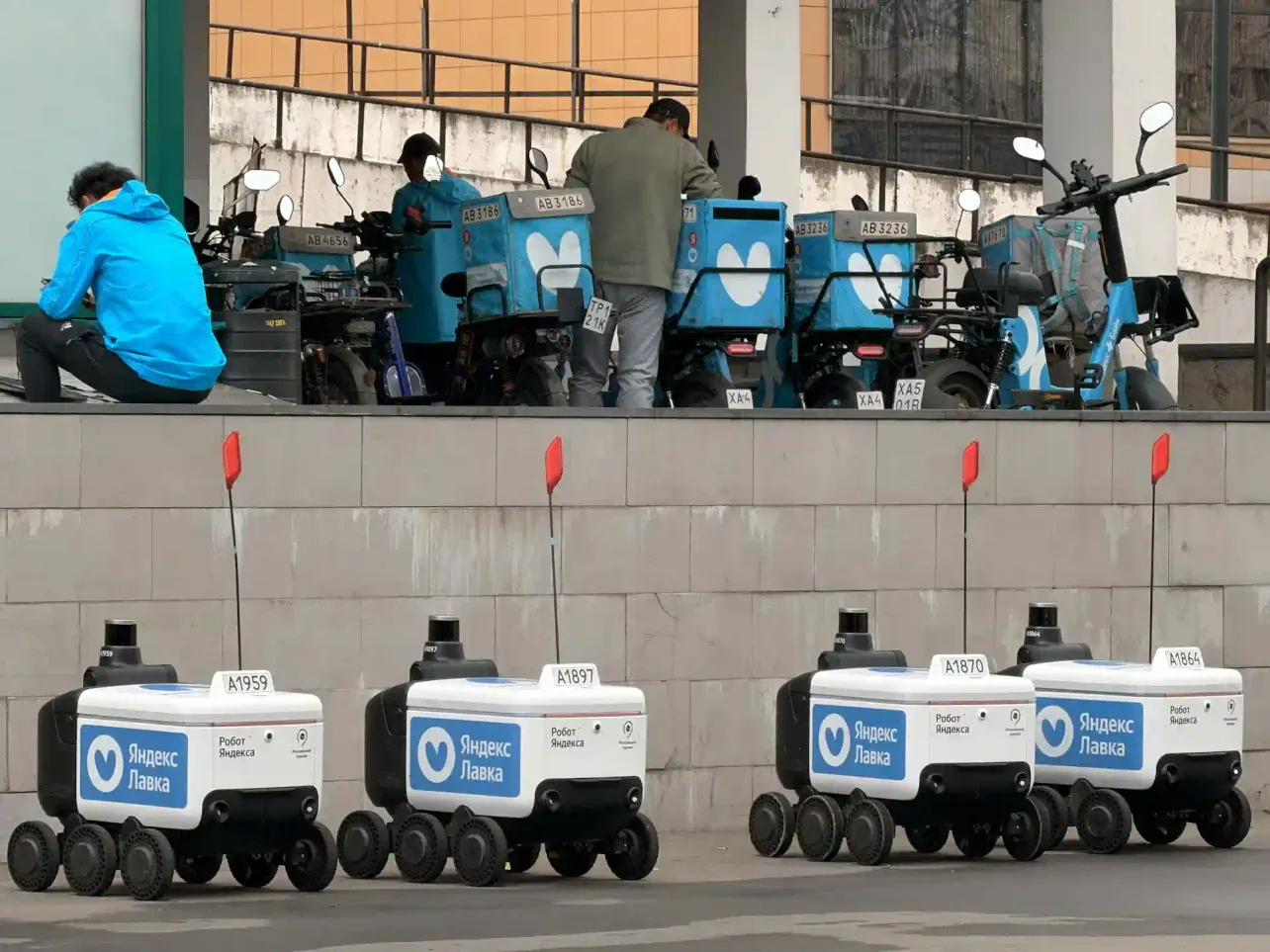
On the road, Waymo went from about 50,000 paid rides a week in May 2024 to 500,000 by March 2026, across 10 US cities (TechCrunch). Its co-CEO, Tekedra Mawakana, is targeting a million a week by the end of this year (Bloomberg). The median US taxi and rideshare driver earns $37,960 (BLS), and it looks like far fewer of these human drivers will be required in the coming years.
The humanoids are catching up
The humanoid robots in the LinkedIn videos might not be the first wave, but they are advancing alarmingly quickly. Global humanoid shipments were roughly 13,000 to 16,000 units in 2025, with Unitree and Agibot each shipping more than 5,000 (Gasgoo, citing China's MIIT). However, China's industry ministry expects domestic output to pass 100,000 this year! Morgan Stanley has raised its China forecast twice in six months and now sees 446,000 units a year by 2030 (The Next Web). Goldman Sachs' base case is 250,000 global shipments in 2030 and 1.4 million in 2035 (Goldman Sachs).
Yeah, sure, today's models are still some way off the sleepless, uncomplaining colleague of the internet hype reels. But for how long? At present, Chinese factory pilots put their robots at 30% - 50% of human productivity, and UBTECH's Walker S2 needs a battery swap every two to three hours (Gadget Review via Yahoo Tech). No sick days, granted, but that's not a lot of productivity and quite a lot of tea breaks.
That's just the situation today, tomorrow is a very different story. UBTECH is forecasting 80% of human efficiency by 2027 (i.e. very soon), and Goldman Sachs says unit costs fell 40% in a single year. Judging humanoids on today's performance is like judging Chat GPT on what it was able to do at the start of 2024.
The timeline
Forecasting all of this is a minefield, but the data supports a reasonable three-phase reading.
2026 to 2030: pilots and shelving units. Robots spread further through warehouses, ports, factories and city streets, while humanoids move from pilots into narrow, supervised jobs. BMW's Figure 02 trial supported production of more than 30,000 X3s over 11 months at Spartanburg, and Figure 03 has now been handed a logistics sequencing job there (The Robot Report). Useful, narrow, and closely watched. Most of the job pressure in this phase comes from warehouse automation, robotaxis spreading to more cities and fixed-position industrial robots. We can safely predict slower hiring in logistics and driving, wage drag in exposed towns and very few headline layoffs.
2030 to 2035: humanoids join the party. Shipments climb into the hundreds of thousands, then low millions, a year. Unit costs, already down to $30,000 to $150,000 (according to Goldman), keep falling. Once a robot reaches around 80% of human efficiency and costs less than two years of a worker's wages, structured physical work in factories, warehouses, commercial kitchens and back-of-store becomes a capex decision rather than a hiring one. Humans will start to feel the loses a lot more.
2035 to 2050: the messy jobs. Construction sites, farms, homes and care settings. Morgan Stanley's model puts 63 million humanoids in the US by 2050, touching 75% of occupations, 40% of employees and roughly $3 trillion in payroll (Morgan Stanley). Yes, you can treat that as a ceiling drawn by people who also sell robot stocks. But you can no longer treat it as fiction.

Find the right people. Search hundreds of screened employer branding agencies, consultants, platforms and specialist providers. The employer branding rabbit hole now has filters.
Who is most exposed
The first wave targets work that is repetitive, physical and done in predictable spaces. Pay data is from the US Bureau of Labor Statistics:
| Role | Main threat | Pressure starts | US median pay |
|---|---|---|---|
| Hand laborers and material movers (6.9m US jobs) | Warehouse robots, then humanoids | Now | $38,220 |
| Taxi, rideshare and chauffeurs | Robotaxis | Now, city by city | $37,960 |
| Delivery drivers | Autonomous vans, sidewalk robots | 2028 to 2035 | $43,950 |
| Heavy truck drivers | Autonomous highway freight | 2028 to 2035 | $58,640 |
| Factory assembly and machine operators | Fixed robots now, humanoids from 2030 | Now, accelerating | Varies |
Further out, Morgan Stanley reckons up to 70% of construction jobs and 67% of farming, fishing and forestry jobs could be affected by 2050.
The least exposed, for now, are roles that combine unpredictable environments with human judgement or human contact: electricians, plumbers and maintenance technicians in other people's buildings, and nurses and care workers. Care is an interesting case; a Stanford-led study of about 860 Japanese nursing homes found robot adoption was linked to roughly 26% higher total employment and fewer retention problems. The robots were filling the gaps, not necessarily replacing the humans. Human to human care could be one of the last bastions to feel the impact, but it's not immune.
And white-collar workers?
For desk workers, the near-term threat is still AI agents. McKinsey estimates current technology could in theory automate about 57% of US work hours: 44% through agents doing desk work and 13% through robots doing physical work (McKinsey Global Institute).
The overlap is subtle. The standard advice to displaced office workers has been "learn a trade". Trades are maybe a sound bet for the next decade. After 2035, the bolt-hole starts to narrow. Robots will also reach the physical tail of white-collar jobs, such as lab technicians, pharmacy dispensing, retail and hotel back-office, facilities. This might be happening slower, but it does look to be happening.
Do the maths
So what does a robot actually cost? Agility Robotics, maker of the Digit warehouse humanoid, set out its own assumptions in a US merger filing in September: about $200,000 to buy a robot, $20,000 to deploy it and $36,000 a year for software and maintenance. Renting one costs about $8,500 a month plus $25,000 to set it up (Physical AI Guide, on Agility's S-4 filing). Spare batteries, power, floor space and the engineers who keep the fleet running come on top. Hyundai's Atlas is estimated at $130,000 to $140,000 a unit in early production, falling to around $30,000 once output passes 50,000 machines (Tech Times).
Now the human. In the US, benefits account for 30% of what private employers spend on their people (BLS). On that ratio, a material mover on the median $38,220 costs an employer about $54,600 a year, or $26.25 per paid hour, before you subtract the holidays and sick days they're paid for but not working.
The robot's real advantage is the clock. Digit runs for 90 minutes and recharges in nine. UBTECH says its Walker S2 swaps its own battery in about three minutes, with no human help, so it can work around the clock (Newsgd). A robot that is 80% as productive as a person but works 20 hours a day delivers 16 human-hours of work. That's two full shifts, every day, with no handover and no overtime.
Put the numbers side by side and the trend is hard to miss:
| Scenario | Annual cost | Output in human-hours a year | Cost per human-hour |
|---|---|---|---|
| Human material mover (US median pay plus benefits) | $54,600 | 2,080 | $26.25 |
| Digit humanoid, bought, 50% as productive (today) | $80,000 | 3,500 | $22.86 |
| Digit humanoid, rented, 50% as productive (today) | $110,300 | 3,500 | $31.52 |
| $30,000 humanoid, 80% as productive (2030s) | $21,000 | 5,600 | $3.75 |
| Same robot, running 24/7 | $21,000 | 7,008 | $3.00 |
EBN estimates. Robots: five-year life, 20 hours a day, 350 days a year (24/7 row: 8,760 hours). Today's costs use Agility's filing assumptions; the 2030s scenario uses a $30,000 unit and Agility's estimate of $15,000 a year to support each robot. Human: BLS median pay for hand laborers and material movers grossed up by the BLS 30% benefits share, 2,080 paid hours. Excludes integration, power, downtime and financing.
Today it's roughly a wash, which is why most deployments are still pilots. However, when you scale it up, one robot does the work of nearly three people for about a seventh of the hourly cost. It's no contest.
And that table flatters the human, because it only counts pay and benefits. Robots take no sick days, holidays or parental leave. They need no health insurance, pension, canteen or Christmas party. Nobody has to recruit them, so there are no job ads, no TA team and no EVP required to attract them. They don't quit, don't need onboarding, training or a career path, and they won't be writing Glassdoor reviews. They do bring new costs: technicians, integration, cybersecurity and the occasional robot that falls over. But most of the HR department's job description simply doesn't apply - so it's not just the displaced worker, it's all the back office and support staff that also get displaced.

Your employees know the truth. Does your EVP? At Fathom we measure the "Credibility Gap" between your promise and their reality.
Who pays
It's not good news, I'm afraid. McKinsey's robot-centric roles, such as drivers and machine operators, average about $42,000 a year. Agent-exposed desk roles average around $70,000. The AI wave hit people with degrees and some savings. The robot wave hits people who tend not to have these things. Hand laborers don't need a formal credential to get the job, which also means they have no credentials to fall back on.
The damage starts out as local. In the best-known study of US robot adoption, MIT's Daron Acemoglu and Boston University's Pascual Restrepo found that each extra robot per 1,000 workers cut the local employment-to-population ratio by 0.18 to 0.34 percentage points and wages by 0.25% to 0.5% (NBER). National averages hide this. Specific towns, built around a distribution centre or a plant, absorb the brunt of it. Oxford Economics made the same point in 2019 when it forecast 20 million manufacturing jobs lost globally by 2030, concentrated in lower-income regions such as Oregon and Cumbria (IndustryWeek).
Even the good news has a catch. In those Japanese nursing homes, all of the extra hiring went to non-regular, often part-time staff. More jobs but with less security. That's the likeliest frontline future across sectors: robots take the steady, predictable hours and humans are left to fill the gaps around them.
Meanwhile, official projections seem worryingly relaxed. The BLS still expects hand laborer and material mover jobs to grow 4% to 2035. Even when Amazon's own documents suggest otherwise.
Follow the money
Let's not forget the bigger societal picture. Wages are how most governments get paid. Across the OECD, personal income tax and social security contributions made up about half of all tax revenue in 2023, at 23.7% and 25.5% respectively (OECD, via RegFollower). As things stand, Robot employees don't pay income tax.
The tax code tilts the field further. Daron Acemoglu, Andrea Manera and Pascual Restrepo estimated that US labour faces an effective tax rate above 28.5%, while equipment and software are taxed at about 5% (Brookings). Their conclusion: the tax system pushes firms to automate more than makes sense for society. Their paper also tracks labour's share of US business income, which fell from 63.6% in 1980 to 56.6% in 2017.
So follow the flow. The employer saves the wages and benefits. The government loses income tax and social contributions just as ageing populations need more of both. The displaced worker loses the income. The savings all land with corporations and shareholders. Left alone, robotics moves money from payrolls and public budgets to corporate balance sheets, and leaves the state with less to support the people it displaced.
Governments have noticed. South Korea, the most automated economy on the planet, is weighing a robot tax, and President Lee Jae Myung has said one could be considered (Korea JoongAng Daily). No country has adopted one yet. Bill Gates has been arguing for one since 2017.
The counterargument deserves a hearing. Robots can fill gaps in shrinking workforces, cheaper goods raise real incomes, and higher profits are taxed too. All true, in theory. It relies on the gains being shared, and four decades of labour share data suggest that's a very big if.
What this means for employer brands
Robots don't read your careers site. The people around them do: the staff who stay, the candidates you still need, the towns you operate in and the politicians who represent them. That's where the employer branding risk sits.
- The rollout becomes the story. In July, Hyundai's union in Ulsan staged partial strikes and demanded that no humanoid robot enter a Hyundai workplace without prior union approval (Tech Times). Hyundai's first Atlas deployment is headed to its non-union plant in Georgia (Seoul Economic Daily). However cleaver the plan, "we sent the robots where nobody could object" isn't a headline any employer brand team wants to manage.
- Euphemisms get leaked. Amazon reportedly weighed swapping "automation" and "AI" for "advanced technology" and "cobot", and considered community projects to soften any backlash (HRD). We know because the documents leaked. Assume yours will too, and write accordingly.
- The frontline EVP has a shelf life. Promising warehouse and plant workers stability and progression while planning to automate their roles is a credibility gap waiting to be found. Promise only what you can keep.
- The people who stay are watching. You'll still need technicians, engineers and the humans who fill the gaps around the machines. They'll judge you on how you treated the people who left, and unlike the robots, they do write Glassdoor reviews.
- Someone will ask where the savings went. If robots cut costs as sharply as the maths suggests, workers, unions, communities and governments will want to know who benefited. Employers with a credible answer, such as retraining, redeployment or shared gains, will have a far easier time than those without one.
Robots are already working warehouse floors and city streets, logging no overtime and generating no job ads. The next generation is coming fast. The question for employers is whether they explain that to their people before the vendor demo and LinkedIn video does.
Takeaways
It's already happening.
Amazon has a million robots and falling headcount per site. Waymo went from 50,000 to 500,000 weekly rides in under two years.
Humanoids are next, and moving fast.
Shipments are forecast to grow from about 15,000 in 2025 to hundreds of thousands a year by 2030, with unit costs falling fast.
Repetitive physical work goes first.
Warehouse, driving and factory roles face pressure now. Skilled trades and care work hold out longest.
The lowest paid go first.
In the US, robot-exposed roles pay roughly 40% less than roles exposed to AI agents. The pattern holds wherever physical work pays least.
The savings flow one way.
At scale, a robot could do nearly three people's work for a fraction of the cost. Governments lose the payroll taxes, workers lose the income and shareholders keep the difference.
Employer brands are in the firing line.
How robots are introduced, explained and paid for will shape how staff, candidates and communities judge employers.