


Key points
- Canva told staff on 4 November that 1,271 people, 22% of the company, are affected by a restructuring. It has not said how many will leave and how many will change roles or relocate.
- Departing staff get at least six months' salary regardless of location, 12 months of healthcare where Canva already provides it, career support and access to US$10,000 grants.
- The deal also changes for people who stay: most hybrid staff are expected in the office two to three days a week from January, and more product teams will be based in Sydney.
- On the day of the announcement, Canva's careers site still said it trusts hybrid staff to choose their work environment.
- Meta and Oracle show how widely layoff processes vary, and that one generous round says little about the next.
- The verdict on Canva's employer brand will come from leavers, remaining staff and candidates over the coming months.
There are plenty of ways to tell someone their job has gone. An email at 6am. A calendar invitation from a stranger in HR. A laptop that no longer recognises its owner.
On Wednesday 4 November, Canva took a longer route. Co-founder and chief executive Melanie Perkins told staff in a letter that 1,271 people, or 22% of the company, would be affected by a restructuring. She called it "the hardest moment in our thirteen-year history". The letter went up on Canva's newsroom the same day, with one of the most detailed departure packages the technology sector has made public.
On LinkedIn, HR and talent leaders lined up to praise it. Several called it a masterclass.
Some of that praise is deserved. It also passes over the harder part for anyone who works in employer branding. For years Canva told candidates they could choose where they worked, and the new operating model takes some of that choice back. The departure package will shape how 1,271 people talk about Canva. The new model will shape how the people who stay talk about it (and those are the people candidates ask).

Your employees know the truth. Does your EVP? At Fathom we measure the "Credibility Gap" between your promise and their reality.
What Canva announced, and what it has not said
Perkins's letter describes a company whose growth "has slowed for the first time in a decade" and which, after "exploring a wide range of alternatives", has concluded that "small changes won't be enough". Her answer is to "refound" Canva around "small, empowered teams".
In practice that means three changes. Product, Growth and Platform will merge into a single product organisation. Narrow specialisms will fold into broader roles, with fewer layers of management. And Sydney "will become the primary home for more of our product teams", with closely linked teams brought together in shared locations. From January, Perkins wrote, "we expect most Hybrid Canvanauts to spend around 2 to 3 days in the office each week, depending on what makes sense in your area."
The 1,271 figure needs care. It counts everyone affected: people whose roles will change, people asked to move to "centralised hubs" and people who will leave. Canva has not said how many fall into each group, or how many of the 1,271 are in Australia. Its teams sit in 37 countries and local requirements apply in each, so timing will vary.
The letter does not blame artificial intelligence. It cites slowing growth, fragmented ownership and how quickly technology is changing what people expect, and it never uses the term AI. (EBN has tracked how rarely executives name AI as the reason for cuts, and how often their staff assume it anyway.)
There is a less comfortable question about how the company got here. Perkins describes complexity that built up as Canva grew: too many handovers, overlapping responsibilities, teams spread too far apart. She concedes the problem is not new. "We've tried many ways to solve this over the years," she wrote, "but it's become clear we need to revisit our underlying structure." Those structures were management decisions, taken over several years. The people now losing their jobs did not design them.
This is by far Canva's largest cut, though not its first. Ten of its 12 technical writers were made redundant in 2025, according to Information Age, and 32 finance roles went in January, The Aussie Corporate reported. In March, the company said it had no plans to lay off staff.
The expensive race behind the restructuring
Canva's restructuring lands at the end of a costly year.
In October 2025 it relaunched Affinity, its professional design software, as a single app that is free to use. It was a direct shot at Adobe's subscription model. Affinity said more than a million people signed up within six days.
The headline numbers still looked strong in early 2026. TechCrunch reported in February that Canva ended 2025 with US$4 billion in annual recurring revenue and more than 265 million monthly active users.
Then the AI bill arrived. In August, Fortune reported that Canva had cut its expected 2026 revenue growth by a third, to 20%, because the cost of delivering AI features had forced it to slow their rollout. Demand had outrun expectations, Perkins told Fortune: "This validated the demand, but also showed us we needed to reduce the cost of completing an AI task."
Investors have marked the company down since. Forbes Australia reports that T. Rowe Price cut the value of its Canva shares by 20%, implying a valuation of about US$30.4 billion at 31 August; Canva entered 2026 valued at US$40 billion. The Australian Financial Review's Street Talk column, as cited by B&T, reported annualised revenue of about US$3.69 billion near the end of October. That figure excludes tax and is measured differently from TechCrunch's ARR number, but the AFR put it roughly where it stood at the start of the year.
None of this shows that making Affinity free caused the job cuts. Canva has drawn no such link, and no public evidence supports one. It does show the pressure on leadership: defending the core product, taking on Adobe, paying for AI and trying to move faster, all at the same time.
For employer branding teams it raises a familiar question. When strategy moves faster than the organisation can follow, who pays to close the gap? Wednesday's letter is one answer.
Six months' salary and a slower goodbye
What sets Canva's announcement apart is how specific it is about leaving.
Departing staff will receive at least six months' salary, inclusive of statutory entitlements, "regardless of location". That floor matters most in countries where the legal minimum is far lower. Canva is also removing the one-year equity vesting cliff for people who joined in the past year, so recent hires leave with some stock.
Healthcare continues for 12 months in countries where Canva already provides it. Canva Care, the employee assistance programme, runs for 12 months and extends to family members. Leavers keep their company MacBook ("as we know not everyone has a personal laptop") and get a year of LinkedIn Premium, one-to-one career coaching and interview preparation. Anyone who wants to start something of their own can register interest by 14 December in the new Canva Collective Fund, which offers US$10,000 grants with no equity taken.
The process details matter as much as the money. Affected staff were offered individual meetings with a senior leader in their area. Departing employees keep Slack and Gmail access until the end of the week, so they can tell colleagues themselves and say goodbye. Non-critical meetings were cancelled for the rest of the week, and anyone who needed time to process the news was told to take the day off without logging it as leave.
That last point is less common than it sounds. When Meta cut more than 11,000 jobs in 2022, it removed departing staff's access to most systems that day, citing sensitive information, and kept their email open only until the day ended.
None of this softens the loss of a job. It does recognise that an employee's final week is still part of their experience of the company, and that they will describe that week to other people.
Employer branding works better when people share what they know. EBClub brings practitioners together to exchange ideas, compare experiences, and learn from the people doing the work.
Canva, Meta and Oracle: three ways to deliver the same news
Large technology employers have had plenty of practice at this. The experience still varies widely.
Mark Zuckerberg's 2022 letter to Meta staff is the nearest comparison to Canva's. He took responsibility for betting on a permanent pandemic-era surge: "I got this wrong, and I take responsibility for that." US staff received 16 weeks' base pay plus two weeks for every year of service, with no cap. They also got six months of healthcare for themselves and their families, and three months of external career support.
Meta's next big round looked different. In May 2026, as it cut about 8,000 jobs and moved investment towards AI, Bloomberg reported that staff in Singapore were the first to be told, at about 4am local time. Generous terms and public accountability in one round did not set the tone for the next.
Oracle sits at the far end. On 31 March an estimated 20,000 to 30,000 employees learned by email that their roles had ended with immediate effect, TechCrunch reported. One found their VPN and Slack access gone first; the severance offer arrived days later. Staff who signed a release received four weeks' pay plus a week for each year of service, capped at 26 weeks. Unvested stock was forfeited, including grants made as retention incentives. When at least 90 employees petitioned for terms closer to those offered by Meta, Microsoft and Cloudflare, Oracle declined to negotiate. It also declined to comment to TechCrunch.
A second round followed in September, again by early-morning email, which the San Francisco Chronicle headlined with the line staff received: "Today is your last working day". Some, including a vice-president in Seattle, said they were locked out of the accounts their termination notices had been sent to, according to Tech Times. Oracle has not said publicly whether that is policy.
The three companies operate across different jurisdictions, contracts and circumstances, and their packages are not directly comparable. The comparison still shows what employees remember: who told them, when and how, what support followed and whether they were treated with dignity. That account does not end with the employment contract.
Praise on LinkedIn, and harder questions in the replies
Perkins also shared the news in a LinkedIn post linking to the letter. By the time EBN reviewed the thread on 4 November, it had more than 2,700 reactions and about 170 comments. Most were warm, and several used the word masterclass.
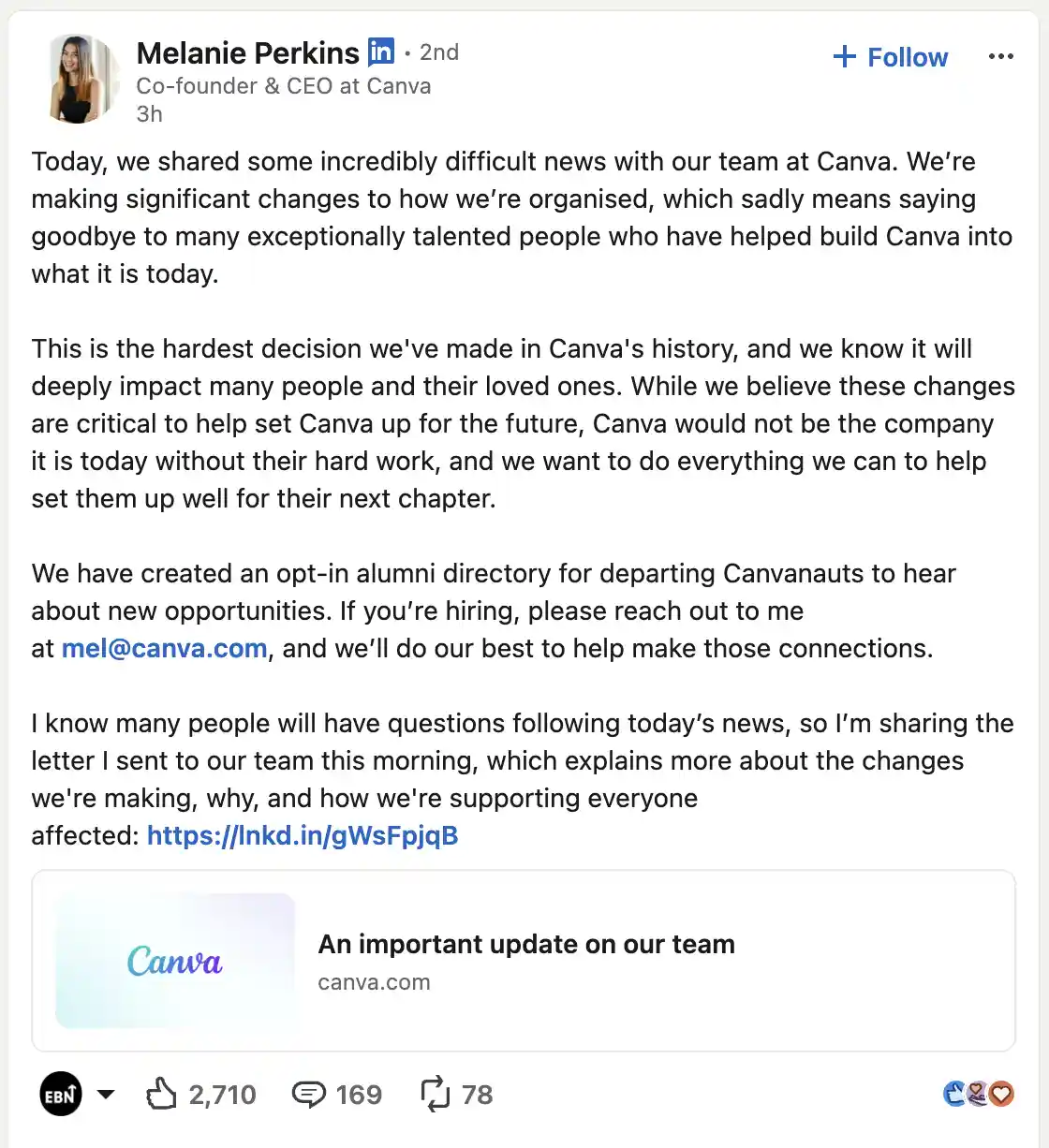
"Of all the 'difficult decision' posts I've read, this one certainly is the most honest and compassionate," wrote Josh G., a four-time CMO and bestselling author. Jemma C, a commercial people director, said the way Canva supports people through unexpected change "really speaks volumes about how much Canva values its team". (Both post under abbreviated surnames.)
Others were less comfortable with the applause. Jacqueline Freedman, a martech adviser, wrote the comment with the most reactions among those EBN reviewed. "I'll give flowers where flowers are due," she began, before listing the salary, healthcare, vesting and grants. "The bag isn't being fumbled." Then she turned to the letter itself, which in her reading "describes years of operating-model drift". If the company had too many layers and overlapping roles, why were they not fixed earlier? It is a fair question. Raman Kumar, a growth marketing lead, offered one remedy: review the org design once a year, "the same way the budget gets reviewed".
Kaylee Keil, a people operations leader, wrote that however positive the package, Canva had "placed all of those once valued employees into a historically challenging job market". The office requirement drew its own response. "Yeah, no," wrote Alice Wells, a proposal management specialist, who called the return to office "a huge turn-off to me as an employer". For someone who cannot move to Sydney or change how they work, a "changed role" can end the same way as a redundancy. And some commenters assumed AI was behind the cuts, whatever the letter said. "That's a lot of words for downsizing for AI," wrote Sean S., a product designer.
Kirsti Smith, an enterprise AI transformation leader, named the problem that tends to get lost amid the focus on departures: "The next challenge is helping those staying ... to find clarity and confidence as their teams change."
These are selected comments from one LinkedIn thread. They do not represent Canva's workforce and say nothing reliable about how affected staff feel. They do show how the news is landing and the general response. Canva is being applauded for how it is handling a painful decision. Whether the people living through it agree is not yet known.
The employer brand promise meets a new reality
Canva has long sold its culture as a reason to join. Its careers site describes a culture that is "unique, human centric and a little bit magical", in which every Canvanaut plays "an active role in evolving our culture". One of its six values is "Be a force for good".
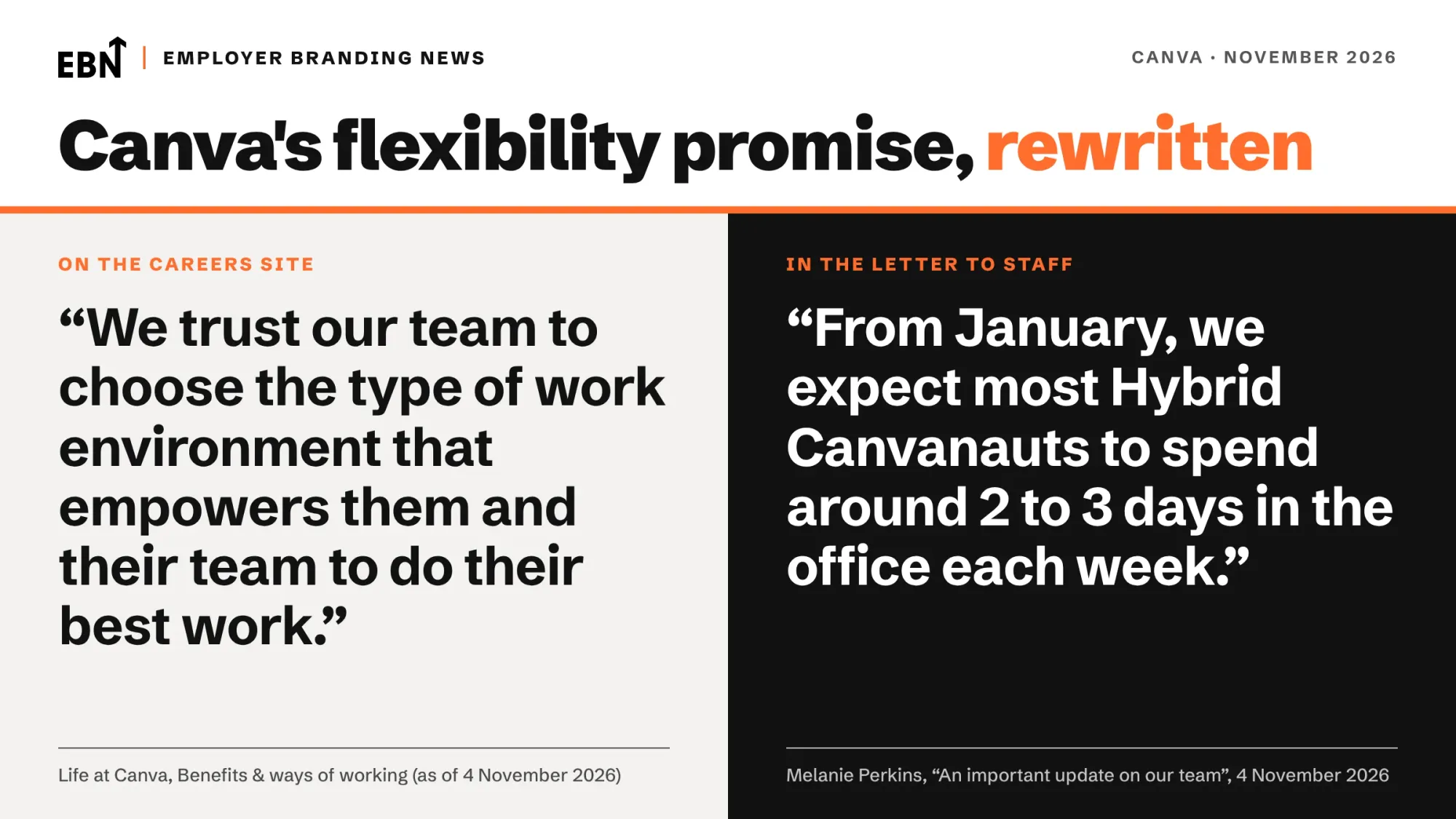
Flexibility has been central to that pitch. The site's benefits and ways of working page says hybrid staff can work from a Canva campus, from home or a mix of both: "We trust our team to choose the type of work environment that empowers them and their team to do their best work." Canva's global head of people, Jennie Rogerson, told Fortune in 2023 that the company was not mandating a return to the office. "People feel trusted that they can work how works best for them," she said.
Forbes Australia reports that a later expectation, working from the nearest hub twice a quarter, was eventually dropped altogether. From January, most hybrid staff will be expected in the office two to three days a week. For people who joined Canva for its flexibility, the deal has changed. For those asked to move to Sydney, it has changed more.
Canva's own talent team has set the standard for handling this. In an interview first published by CEO Magazine and republished by ATC in June, talent attraction lead Charlotte Anderson said: "Having an EVP that's authentic and true to the experience of your team holds you accountable." An authentic employer value proposition, she added, "minimizes the expectations gap".
It is a good standard, and it applies now. Canva is entitled to change its operating model. Its EVP has to change with it, in public, so that candidates who read the careers site in January are reading about the job they will actually do. On the day of the announcement, the ways of working page still carried the trust-to-choose wording. EBN has argued before that the dangerous part of an EVP comes after it is written; this is what that looks like.
Canva's employer brand team now has to explain a new way of working while keeping its values credible. Some of the people who built that reputation are among those leaving.
Canva's recruiters are working in reverse
For talent acquisition teams, one detail stands out. Canva says it is "dedicating a significant portion of our Talent Acquisition team" to helping departing staff review their resumes and practise for interviews. It is also building an opt-in alumni talent directory, which it will "proactively share" with its investors, partners and wider industry network. Perkins then put her own inbox on the line. "If you're hiring, please reach out to me at mel@canva.com," she wrote on LinkedIn, "and we'll do our best to help make those connections."
That turns a function built to bring people in towards helping them out. Recruiters know the market, hold the networks and spend their days helping people put a value on their own experience. In a restructuring those skills have obvious use for departing colleagues, and at Canva the effort runs from the recruiters all the way to the chief executive.
An alumni programme stretches the idea further. Raman Kumar put the commercial case in the comments: "A lot of these folks will end up at customers, partners or even competitors someday, and how this day was handled is what they'll remember when Canva comes up."
The offers have started. Christopher Fong, who says he started the 35,000-member Xoogler.co community for former Googlers, offered to help "foster the ex-Canva community for folks to help hire each other and refer candidates". Staff at Arm, Mentimeter and CorePlan posted openings in the thread, and several commenters said they had already emailed Perkins. Offers are a start. The directory's worth will show in interviews secured and jobs found, and Canva has not said whether it will report either.
For employer brand teams the lesson is about timing. Their place in a workforce transition is alongside HR, talent acquisition, communications and leadership, before the announcement is written.
The people who stay
The departure experience is half of Canva's test. Remaining staff face new teams, redistributed work, fewer managers and, for many, a new commute. Some will be worried about their own jobs. Most will have lost colleagues. (EBN looked at what layoffs ask of the people who keep their jobs in September.)
Canva's stated aim gives a clear yardstick. If the refounding works, employees should report more autonomy, faster decisions, manageable workloads and recovering trust in leadership. If it does not, candidates will hear about it from current staff, former staff and review sites long before any careers page catches up.
What employer branding teams should measure after layoffs
The Canva case suggests a working framework for any organisation planning or reviewing a restructuring. These are proposed measures; Canva has not reported against any of them.
Before an announcement, employer brand teams should test the planned changes against existing employee promises, candidate expectations and the credibility of stated values. During it, the test is clarity. Do employees understand what is changing, why, and what it means for them personally?
The longer-term measures say more.
- Departure experience. Did people get clear information, timely conversations and the support they were promised? Were differences between countries explained?
- Career outcomes. How many leavers used coaching and the alumni directory? How many had interviews or new jobs within three and six months? Did they find the support useful?
- Employee trust. How do remaining staff rate leadership credibility, psychological safety, workload and confidence in the company's direction?
- Employer reputation. What themes surface in feedback from leavers, candidates and review sites, and do they point to isolated frustration or a consistent gap between promise and experience?
- EVP alignment. Have careers pages, job ads and recruiter scripts been updated to describe the new working arrangements accurately?
- Organisational change. A year on, is the promised gain in autonomy and speed visible?

Find the right people. Search hundreds of screened employer branding agencies, consultants, platforms and specialist providers. The employer branding rabbit hole now has filters.
The verdict on Canva has not arrived
Canva has made commitments other employers should study. The money is generous. The career support draws on its own recruiters. The alumni directory treats the relationship as something that continues after employment ends. Letting people leave on their own terms shows an understanding of how these moments are lived.
None of that makes the job losses small, or the decisions behind them immune from scrutiny.
The company all-hands on 10 November and the Collective Fund deadline on 14 December are the first checkpoints. The real evaluation will take longer, once people have lived through the transition and the new organisation is up and running.
There is always a temptation to crown a winner when one layoff letter reads more humanely than another. Employer branding runs on a longer clock than a LinkedIn post. A company's reputation is built from what people carry away from it, including the people it no longer employs. Canva has published an unusually detailed promise about how it will treat them. Whether the experience matches it is the part that counts.
Takeaways
How many people are affected by Canva's restructuring?
Canva told staff on 4 November 2026 that 1,271 people, about 22% of its workforce, are affected. The total covers people whose roles will change, people asked to relocate to central hubs and people who will leave. Canva has not published the split.
What is in Canva's redundancy package?
At least six months' salary inclusive of statutory entitlements, regardless of location; removal of the one-year vesting cliff for recent joiners; 12 months of healthcare where Canva already provides it; 12 months of its employee assistance programme, extended to family members; a company MacBook, a year of LinkedIn Premium, coaching and an opt-in alumni directory; and US$10,000 Collective Fund grants with no equity taken.
How does Canva's package compare with Meta and Oracle?
Meta's 2022 US package paid 16 weeks' base pay plus two weeks per year of service, with six months of healthcare. Oracle's March 2026 terms, as reported by TechCrunch, paid four weeks plus one week per year of service, capped at 26 weeks and conditional on a signed release. Jurisdictions and contracts differ, so the packages are not directly comparable.
Is Canva changing its flexible working arrangements?
Yes. From January 2027 most hybrid staff are expected in the office around two to three days a week, and Sydney becomes the primary home for more product teams. Canva's careers site had described hybrid staff choosing their own work environment.
What should employer branding teams measure after layoffs?
The departure experience, career outcomes for leavers, trust among remaining staff, reputation themes from leavers, candidates and review sites, and whether careers content describes the new working arrangements accurately.