

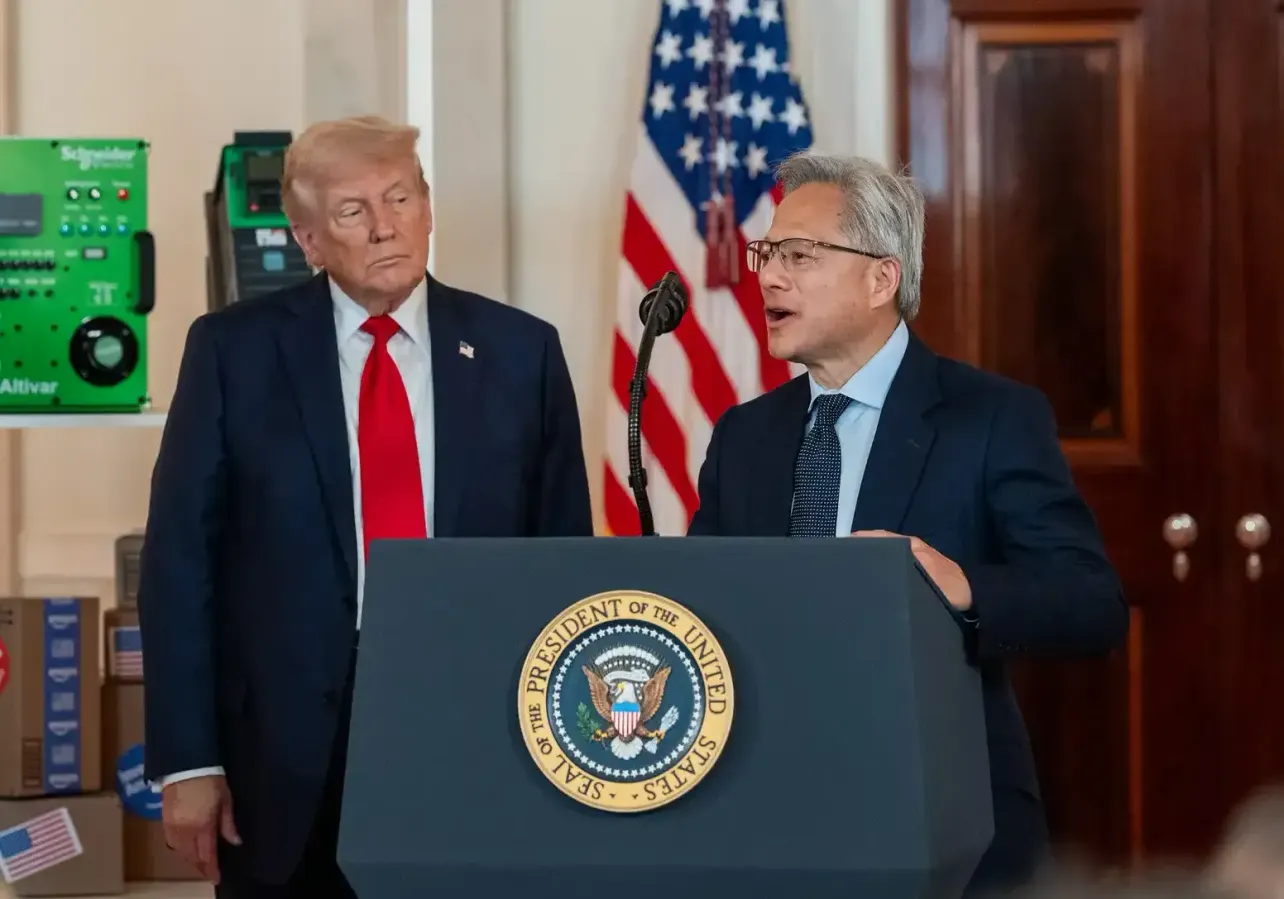
Key points
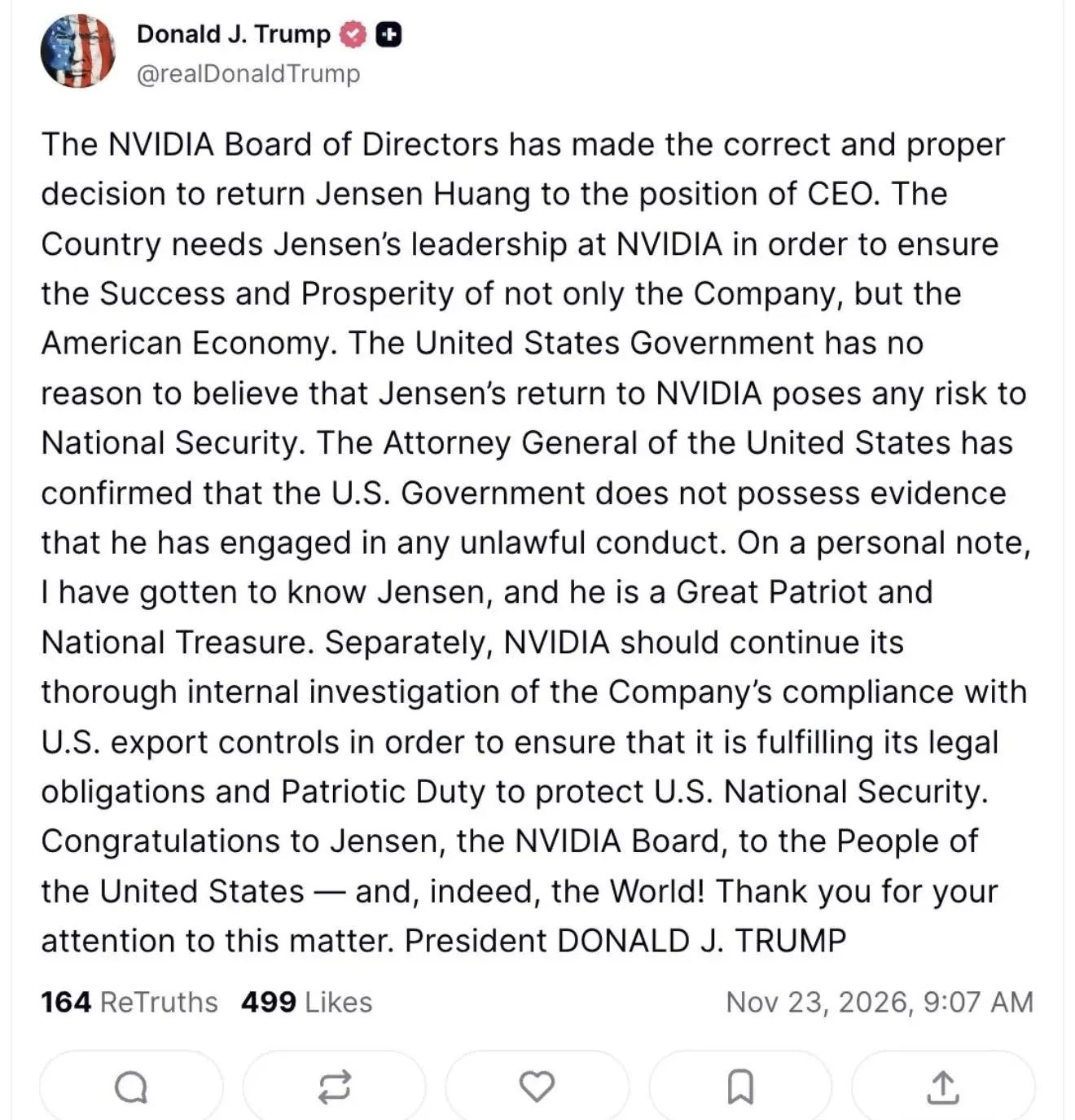
- Nvidia announced Jensen Huang's resignation on 12 November, said on 17 November it did not intend to bring him back, then announced on 23 November that the board had voted unanimously to reinstate him.
- In the eleven days between, employees petitioned, posted and laid flowers, one engineer quit over the lack of explanation, and interim management pulled the annual pay and equity review forward from March to December.
- The reinstatement statement mentioned Huang's candour and ability to lead. It did not mention the reported relationships with Nvidia employees, and the board's own investigation is still open.
- Current staff heard that their voice counted. Many future candidates will hear that the rules depend on how hard you are to replace. Both readings are understandable.
- The reinstatement came with a national security committee and a compliance officer search. Nothing in it speaks to workplace conduct, which is the question many employees and candidates are asking.
- The reinstatement added about US$950 billion to Nvidia in a day and lifted the Nasdaq 6.5%. As a business decision it needs little explaining. As a statement of values it leaves a lot unsaid.
- Founder dependence is a retention plan with a single point of failure. Most companies do not have Nvidia's share price to paper over the cracks.
Eleven days
That is how long Nvidia lasted without Jensen Huang. On 12 November Nvidia announced that the board had accepted his resignation as president, chief executive and director, and named CFO Colette Kress interim CEO. On 17 November the new chair, Harvey Jones, told analysts the board "does not intend to reinstate Jensen as CEO" (Forbes). On 23 November it announced that it had reinstated him, after a unanimous vote the day before and what it called "input from senior levels of the United States government" (Nvidia). The shares rose 31.5% on the day, adding about US$950 billion of market value.
When EBN looked at Huang's apology letter on 9 November, the argument was that Nvidia's employer brand runs on one man, and that this is a risk. The fortnight since has run that stress test live, with 42,000 employees and most of the AI talent market watching.

Your employees know the truth. Does your EVP? At Fathom we measure the "Credibility Gap" between your promise and their reality.
What eleven days without him looked like
The workforce response was fast and loud. A day after the resignation, an internal post asking the board to weigh staff sentiment had drawn more than 1,600 comments, most backing Huang's return (TweakTown, citing WIRED). Flowers and candles appeared by the sign outside Santa Clara headquarters (Digit). An outside open letter, Stand with Jensen, passed 175,000 names, around 8,800 of them self-identified as Nvidia staff (TNW).
Then the first public exit. A senior research engineer in Nvidia's Shanghai robotics unit resigned publicly. His complaint was about process, he said he could not prejudge the investigation, but could not accept "having to come to terms with his departure before receiving an explanation that helps me understand it" (BigGo Finance). Not everyone was on the petition side, though. Bryan Catanzaro, Nvidia's vice president of applied deep learning research, called a letter circulating in his name "clearly fake" and backed the board and Kress (Xenospectrum).
Scott Galloway's view of the return, from The Prof G Pod. Many of the staff who cheered would call it loyalty.
On 18 November Kress held her first all-hands. Staff had submitted around 700 questions in advance. Compensation came first and board transparency second (24/7 Wall St.). Her answer was to move the annual review, where Nvidia staff typically get raises and fresh stock, from March to December. "Let's move forward," she told them (People Matters). A senior employee had already written to the board warning it "could lose key talent".
When the stock is the pay, the founder is the pay
This is what founder dependence looks like at scale. Nvidia leans heavily on equity to keep its people, so the share price is a big part of the retention plan. By the day of the all-hands the stock had closed about 37% below its 6 October record (24/7 Wall St.). Unvested grants shrank and rival offers started to look better.
So management reached for the quickest lever it had and brought the money forward. That is a sensible tactic and a revealing one. However, the staff signing petitions were asking for an explanation and a person, and a pay review gave them neither.
From a pure retention point of view, the board's U-turn is defensible. Huang is the CUDA bet, the weekly Top 5 emails, and the flat structure with around 60 direct reports. Employees told the board, loudly and publicly, that he was why they stayed. You could say that here, the board listened to its workforce, which is something plenty of HR teams never quite get.
We have seen this film before. In November 2023 OpenAI's board removed Sam Altman, more than 700 of its roughly 770 staff threatened to follow him to Microsoft, and four days later he was back (SCMP; AP). The details differ, but the lesson travels: once staff and investors decide the founder is the company, the board has very little room left.
A trillion-dollar character reference
To understand the board's decision it helps to start with the cold numbers. Nvidia closed at US$173.73 on 11 November, the last close before the resignation was announced. By Friday 20 November it was at US$125.53, down about 28% in seven trading days (The Motley Fool). On EBN's arithmetic from those closing prices, that is more than a trillion dollars of market value. Not all of it was Huang: the wider market had a bruising week too, with the major indices down roughly 7% to 10% on worries about funding the AI build-out (AFP). On the day of the reinstatement the shares closed up 31.5% at US$165.05, adding about US$950 billion, and the Nasdaq rose 6.5%. At the end of the day, Nvidia finished about 5% below where it started.
That money was never only Silicon Valley's. Nvidia made up roughly 8% of the S&P 500 in mid-November, and a much bigger slice of some technology funds commonly found in retirement plans. Axios worked out that, holding everything else still, a 30% fall in Nvidia takes about US$2,400 off every US$100,000 held in an S&P 500 fund (Axios). Nvidia's own staff, many of them holding plenty of stock, were among the most impacted.
Seen through that lens, the board's decision needs very little explaining. Neither does the White House's interest. Trump told PBS that "the bigger threat would be losing the brainpower of somebody like Jensen" (PBS NewsHour). When one man's employment status moves the index sitting in millions of pensions, his conduct stops being only an HR matter.

Find the right people. Search hundreds of screened employer branding agencies, consultants, platforms and specialist providers. The employer branding rabbit hole now has filters.
What everyone else heard
It is worth remembering what the board said a week earlier. On 17 November Jones told analysts that Huang had resigned after disclosing "personal behavior inconsistent with the company's code of conduct, standards and cultural norms" (NPR). That Code applies to "every NVIDIA employee and board member", and says "managers serve as role models" (Code of Conduct). Hence the headline. The Code hasn't been suspended and the investigation continues, but the same board that measured Huang against it has now waved him back in.
The reinstatement statement said the board was "satisfied with respect to Mr. Huang's candor and ability to lead" (Nvidia), nine days after Reuters reported that he had "misled several Nvidia leaders" about his relationship with Alice Huang (TNW, citing Reuters). It said nothing about the reported relationships with Nvidia employees, including one with an executive who reports to him, which neither Huang nor Nvidia has confirmed. The return did come with a National Security and Export Control Committee and a search for a Chief Compliance Officer (Nvidia). In other words, Nvidia has told regulators the rules are getting tighter. It has yet to say the same to its staff. Bo Young Lee, an AI and workplace ethics expert, told USA TODAY the omission implies that behaviour is acceptable at Nvidia and across Silicon Valley. Fatima Goss Graves of the National Women's Law Center said: "When a CEO has a relationship with an employee who reports to him, the power imbalance cannot be ignored" (USA TODAY via AOL).
Then there is the detail the comms team would rather you skipped. On 20 November the New York Times reported that Nvidia paid more than US$1 million in a confidential settlement to its former HR chief, Michael Winston, who says he was fired in 2004 after objecting to Huang's behaviour. Neither side admitted liability, and Huang's spokesperson called the claims "fabrications" (TechTimes, citing the NYT). A settlement proves nothing about the allegations. But for anyone weighing whether to speak up at work, the story isn't reassuring. Nvidia does have an anonymous Speak Up line and a written promise not to retaliate (Code of Conduct). The question is whether staff believe it works when the subject is the founder.
The board's investigation is still running. Huang is due before three House committees on 1 December, has agreed to appear before the Senate Banking Committee, and California's attorney general has issued a subpoena (Forbes). The reinstatement arrived before any of the findings. Most of Nvidia's 42,000 people work under the same code of conduct, and few of them would expect it to bend this far for them. The lesson many could draw is that the rules come in tiers, and the tier is set by replaceability.
That is the LinkedIn argument, and both camps have a point. The accountability crowd is right about the message. The "Jensen is the employer brand" crowd is right about the retention maths. The tough part is that both are describing the same decision.
The many and the few
Underneath the LinkedIn noise is a harder question. Is it reasonable to weigh a trillion dollars, spread across employees, pension savers and index funds, against the expectation, among the much smaller number of people who work close to a powerful boss, that the rules apply to him too? Put like that, it sounds like simple arithmetic, and the many win.
The arithmetic has three problems. The first is that it was never a straight choice. A board can keep a founder and still set terms: an independent chair with real authority, a conduct clause, a reporting line that bypasses the CEO, a published outcome to the investigation. Nvidia set terms for national security, so it knows how. On conduct, it has offered none of it (yet).
The second is that the few are not that few. Everyone who joins Nvidia from here, and everyone at a company whose board is taking notes, inherits the precedent. The third is that the trillion dollars fell as hard as it did partly because a company of that size had no credible plan for life without one man. Reinstating him repaired the share price. It did nothing for the dependency.
The many also include Nvidia's own workforce, whose equity fell with Huang and rose with him. For a lot of staff, loyalty and net worth pointed the same way. That does not make the petitions cynical, but it does make the applause weaker evidence about values than it looks.
Employer brands are built for the people deciding whether to join, and they price risk differently from shareholders. A shareholder can sell tomorrow. An employee who reports to the CEO has fewer options.
Two audiences, one decision
An EVP is meant to be a promise that holds for everyone in the building. Nvidia has just shown it holds differently depending on who is listening.
A senior GPU architect choosing between Nvidia and a rival probably hears "the visionary stays, the equity recovers". A woman early in her career, or anyone who has ever reported misconduct, may hear something completely different. A compliance-minded candidate in a regulated market hears that a national security question was waved through with input from the White House, while the investigations carry on. Segmenting an EVP by audience is standard practice for things like location or band, but not ethics.
Nvidia will probably absorb this. Turnover was 3.7% in fiscal 2026 (Form 10-K), the work is the most sought-after in tech and the equity is back in fashion. Most companies don't have such a plush cushion.

Employer branding works better when people share what they know. EBClub brings practitioners together to exchange ideas, compare experiences, and learn from the people doing the work.
What employer brand teams should take from it
- Your code of conduct is careers content. Candidates judge you on what you enforce, not what you claim. Every time a high-profile exception is made the message on what the company values is sent loud and clear.
- One person plus one share price is one retention plan. Build a second. Give senior leaders below the founder a visible public profile, and tell career stories that do not all route through the CEO.
- When leadership reverses itself, explain it inside first, and in full. Nvidia's first public resignation came from an engineer who said he had not been given an explanation. Silence costs more than a bumpy all-hands meeting.
- Measure the split, not the average. Average sentiment at Nvidia is probably buoyant this week. The real sentiment should be measured by segment, with particular attention paid to groups such as women, early-career hires and staff without meaningful equity.
Nvidia's staff got their founder back. The candidates watching got a clear view of how the company ranks its stated values once they start costing money. Both groups will factor the events of this week in when making their next career decision.
Takeaways
Why was Jensen Huang reinstated as Nvidia CEO?
Nvidia's board voted unanimously on 22 November 2026 and announced it on 23 November. It said it was satisfied with Huang's candour and ability to lead, and that input from senior US government officials left it confident his return posed no national security risk. The vote came eleven days after the board accepted his resignation and five days after its chair said he would not return.
Did Nvidia announce governance changes when Huang returned?
Yes. The board formed a National Security and Export Control Committee of independent directors, which is engaging counsel with national security experience, began a search for a Chief Compliance Officer reporting to the Nominating and Corporate Governance Committee, kept Harvey Jones as chair and said its independent investigation will proceed to conclusion. The announcement did not address workplace conduct.
How did Nvidia employees react to Huang's resignation?
Visible support for his return was large: more than 1,600 comments on one internal post, according to WIRED, and 8,766 self-identified staff on an outside open letter. It was not unanimous. A vice president publicly backed the board and interim CEO, and an engineer resigned over the lack of explanation. Most employees said nothing in public.
Does Nvidia have a whistleblower hotline?
Yes. Its Code of Conduct describes an anonymous Speak Up line, investigation of reports by its Compliance Committee and protection against retaliation for good-faith reports. The open question is how confident employees feel using it when a concern involves the founder and CEO.
What message does the reinstatement send to current and future talent?
It depends on who is listening. Staff with significant equity or loyalty to Huang may see stability. Employees concerned about leadership conduct, and candidates without a financial stake, may read it as a sign that standards depend on seniority. Future managers see how commercial value is weighed against behaviour.
How much was Jensen Huang's return worth to Nvidia?
Nvidia shares closed 31.5% higher on 23 November 2026, adding about US$950 billion in market value, though still about 5% below the last close before his resignation was announced. The wider market was also volatile, so not all of the earlier fall or the rebound can be attributed to Huang.