


The premise of "Building expertise in the age of AI: Who trains the next generation?", published by McKinsey Quarterly on 14 July, is one almost nobody in talent disputes. The routine work that used to turn a graduate into a practitioner (the research, the documentation, the data cleanup, the first-pass analysis) is being absorbed by software. Take away the boring work and you take away the apprenticeship that came free with it.
Bryan Hancock and Charlotte Seiler, who wrote the piece, then do something more useful than restate the problem. They propose a fix with four parts: codify how your best people think so AI systems can serve it up, redesign entry-level roles around supervising machine output, embed learning in real work through what they call an "answer key" model, and turn managers into coaches.
It is the most coherent employer-side answer currently in circulation. It is also, in three places, resting on less than it appears to be.

Your employees know the truth. Does your EVP? At Fathom we measure the "Credibility Gap" between your promise and their reality.
What the piece gets right
Start with the honest parts, because there are several and they are unusual for a consultancy publication.
The article does not oversell the labour-market evidence. It cites the Stanford Digital Economy Lab finding that workers aged 22 to 25 in the most AI-exposed occupations saw a 16 percent relative employment decline. Then it notes that Federal Reserve Bank of New York economists attribute much of the same rise in young-graduate unemployment to remote work, and that Yale's Budget Lab finds no economy-wide AI fingerprint at all. Its conclusion from that mess is the right one: whatever is eroding the apprenticeship channel, employers cannot assume it still works.
Hancock and Seiler also quote two Microsoft engineering leaders, Mark Russinovich and Scott Hanselman, whose framing is blunter than anything McKinsey would write in its own voice. Agentic coding tools give senior engineers an "AI boost" and impose an "AI drag" on juniors who lack the judgment to check the output. The rational response is to hire seniors and automate juniors, which quietly removes the bottom of the pyramid every senior role depends on.
And the article's own exhibit is more interesting than the sentence introducing it. Asked whether gen AI is reducing the need for entry-level roles, 49 percent of respondents to McKinsey's New Era of Work Survey said it was not happening in their organisation. Another 42 percent reported it in a few or some roles. Only 8 percent said many or most. So the erosion is real, widely reported, and at most organisations still shallow. (McKinsey puts the sample at 28,000 and dates it September 2025. It has not published the survey's methodology, so the figure cannot be checked independently.)
The answer key has no answers
The centrepiece is the answer-key model, described in the article like this: "The employee attempts first, the AI grades the attempt, and the employee sits down with a manager, who discusses the differences."
As a piece of instructional design, the sequencing is sound. Attempt, then check, is retrieval practice, one of the better-established effects in learning science, and it long predates any of this. The problem is the evidence McKinsey recruits to support it.
Two clinical trials do the heavy lifting. The article says that giving physicians an LLM "barely improved their long-term diagnostic performance", while a workflow requiring them to "compare and reconcile their own reasoning with that of the AI model lifted performance in future situations to the level of the AI model alone."
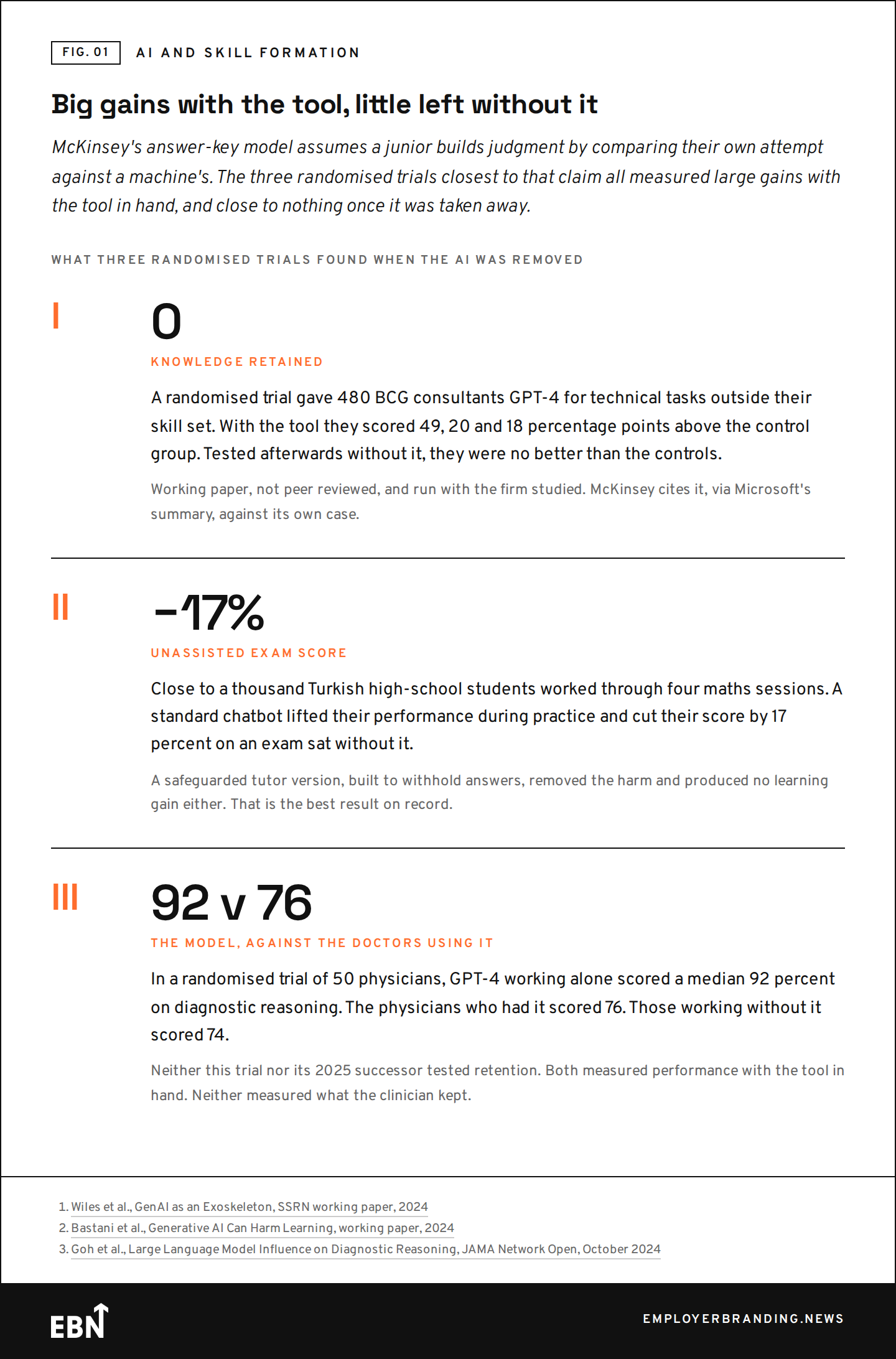
Neither study measured performance in future situations. The first was a randomised trial of 50 physicians across 244 cases, published in JAMA Network Open in October 2024. It scored diagnostic reasoning with the tool in hand and found no meaningful difference: a median 76 percent for the LLM arm against 74 percent for conventional resources, an adjusted gap of 2 percentage points at p = 0.60. The second, 92 physicians in Nature Medicine in February 2025, measured management reasoning in the same in-task way and found a 6.5 point gain. There is no retention test, no follow-up and no transfer test in either paper. There was also no compare-and-reconcile workflow. Both trials simply handed doctors GPT-4 alongside UpToDate and Google, and the JAMA authors say explicitly that participants "were not forced to use the system in any consistent way."
So the contrast McKinsey draws between two workflows is a contrast between two studies of the same intervention.
The uncomfortable number is the one the article leaves out. In the JAMA trial, GPT-4 working alone scored a median 92 percent. The physicians who had it scored 76. Handed a tool that outperformed them by 16 points, they captured almost none of it. That is a supervision result, and it is exactly what the largest synthesis of the question predicts. Michelle Vaccaro, Abdullah Almaatouq and Thomas Malone reviewed more than 100 experiments and over 300 effect sizes in Nature Human Behaviour in 2024. Human-AI combinations, they found, on average "performed significantly worse than the best of humans or AI alone". The losses clustered in decision tasks, and in the cases where the AI was the stronger party.
Pair a novice with a strong model and you have built the worst configuration in that literature. Then ask the novice to grade it.
The article's other piece of learning-science evidence is thinner still. McKinsey reports that first-year medical students who worked through AI-generated cases with automated feedback over five days beat second-year students on the targeted diagnoses, and that "the learning persisted" at a two-week follow-up. The study, in the Journal of Surgical Education last October, is real and the direction of effect is as described. It is also not randomised, sets 38 first-years against 33 second-years from a different cohort at a single university in Ankara, and covers five abdominal conditions. Two weeks is a short delayed post-test. And the system it tests is fully automated with no human in the loop, which removes the third step of the model it is being used to defend.
The one citation McKinsey uses against itself is the strongest. Drawing on Microsoft's New Future of Work report, the article notes that when workers used gen AI to do technical tasks they could not do themselves, "the capability vanished the moment AI access was removed." That comes from a randomised trial of 480 BCG consultants: large in-task gains, no knowledge acquired. The best-known school experiment points the same way. Hamsa Bastani and colleagues ran four maths sessions with close to a thousand Turkish high-school students. A standard chatbot cut unassisted exam performance by 17 percent. A purpose-built tutor version, designed to withhold answers, removed the harm and produced no learning gain at all.
That is the state of the art. The best-designed AI scaffold measured so far got learners back to par.
Convergence is not judgment
There is a subtler problem, and it sits in the metric.
McKinsey proposes measuring development by the gap between the employee's independent attempt and the model's output, calling a narrowing gap "direct evidence that judgment is forming." It is an appealing idea precisely because apprenticeship has never had a number.
But that number measures agreement with the model. It does not measure correctness. In medicine there is a gold-standard diagnosis behind the answer key. In an EVP diagnostic, a workforce plan or a market assessment there is no such thing, and the model's output is a confident average of what has been written before. Optimise for a closing gap and you reward the junior who learns to sound like the tool. Worse, you penalise the one who was right when it was wrong.

Employer branding now has a measurement standard. The Talent Gravity Standard is a six-driver framework for quantifying employer attractiveness and the gap between brand promise and employee experience.
Matt Beane, whose book The Skill Code McKinsey cites approvingly, put the point sharply in an interview in July. "All AI can do most of the time is create B-plus content, lots of free B-plus content, and you will forget what an A-plus looks like."
Beane's own field research complicates the model further. His study of robotic surgery, published in Administrative Science Quarterly in 2019, found that residents got ten to twenty times less hands-on practice than in open surgery, because the technology let the attending operate alone. The residents who did build skill broke the rules to get their hands on the controls. Beane calls that shadow learning. The ones who followed the approved path got what he calls helicopter teaching: watching a superior operator, taking periodic feedback, and building less skill.
The coaching bill
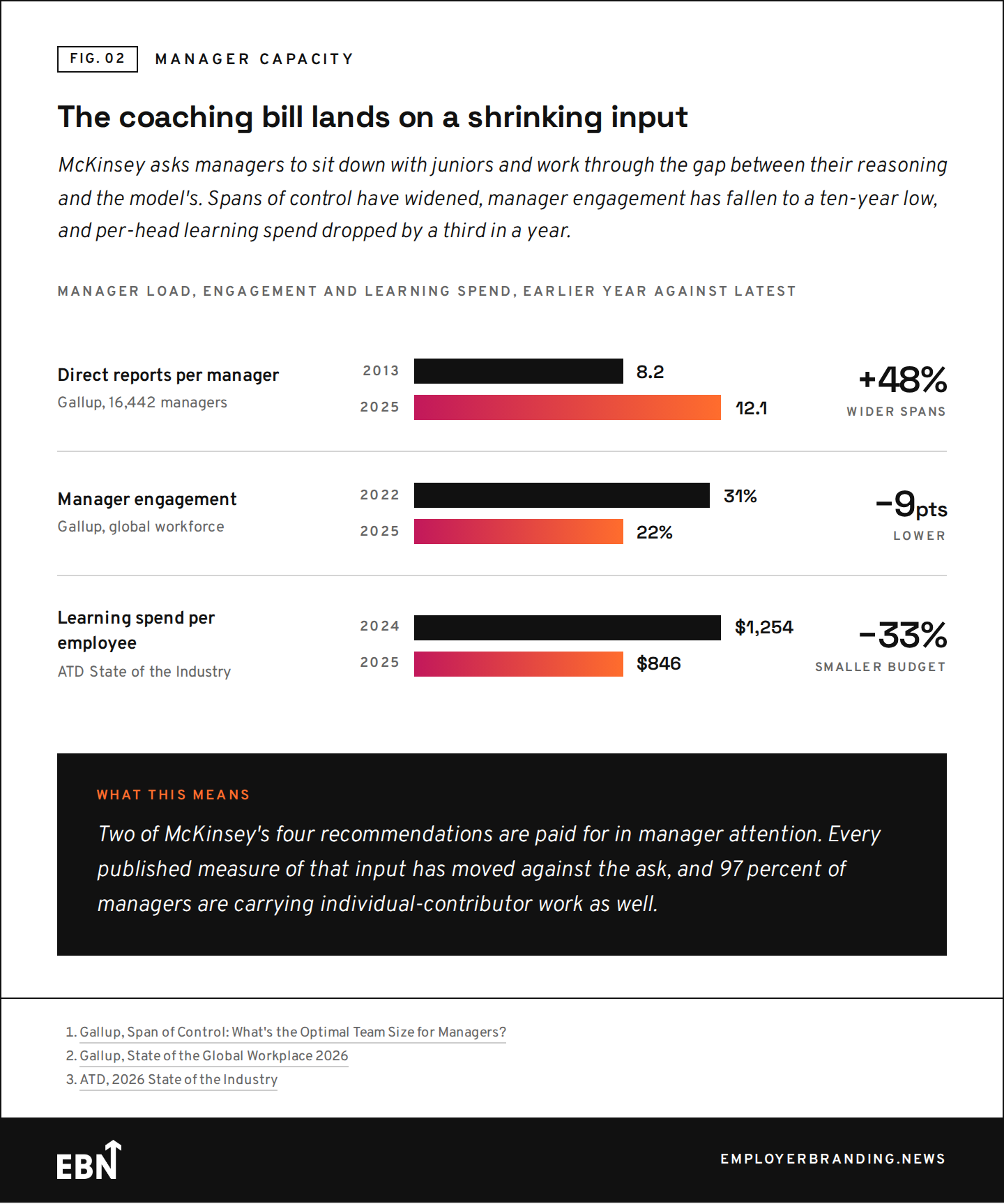
Two of McKinsey's four recommendations are paid for in manager time, which is the input employers have spent three years cutting.
Gallup's analysis of 16,442 managers puts average direct reports at 12.1 in 2025, up from 8.2 in 2013. Ninety-seven percent of managers also carry individual-contributor work, and the median manager spends 40 percent of their time on it. Thirteen percent now oversee 25 people or more.
Then there is McKinsey's own evidence. Its HR Monitor 2026, published on 8 June, covered roughly 1,300 HR professionals and 5,500 employees across ten countries. It found that 24 percent of employees report no training participation at all, that more than half receive feedback once a year or never, and that 11 percent of organisations take a long-term view of workforce planning. Those findings sit in the same building as a proposal for managers to work through AI-versus-human reasoning differences on individual pieces of junior work.
Nor has AI created the room. In a Gartner survey published in March, covering managers, employees and HR leaders, 7 percent of organisations gave any guidance on how time saved by AI should be used. Whatever the tools free up is being absorbed rather than reinvested.
Compare the two prescriptions on the table. Russinovich and Hanselman propose a preceptor model in which a senior engineer formally mentors a small cohort for a year or more, and, in their version, mentorship is measured and compensated as a primary deliverable. McKinsey recommends treating coaching as "a core capability, not as an afterthought."
One is a change to the reward system. The other is an exhortation, and HR has an archive full of those.
The general athlete has been tried
McKinsey's role-design advice is to hire for judgment over tool fluency, widen the aperture beyond formal qualifications, and look for a "general athlete" rather than a narrow specialist. A head of HR at a Fortune 100 company is quoted describing exactly that.
This recommendation has a track record. It is skills-based hiring, and the Burning Glass Institute and Harvard Business School measured what happened when employers adopted it. Across 11,300 roles at large US firms between 2014 and 2023, dropping the degree requirement raised non-degree hiring in those specific roles by 3.5 percentage points. Across all hiring the net effect was 0.14 percentage points, or fewer than one in every 700 new hires. Forty-five percent of the firms changed the wording and nothing else.
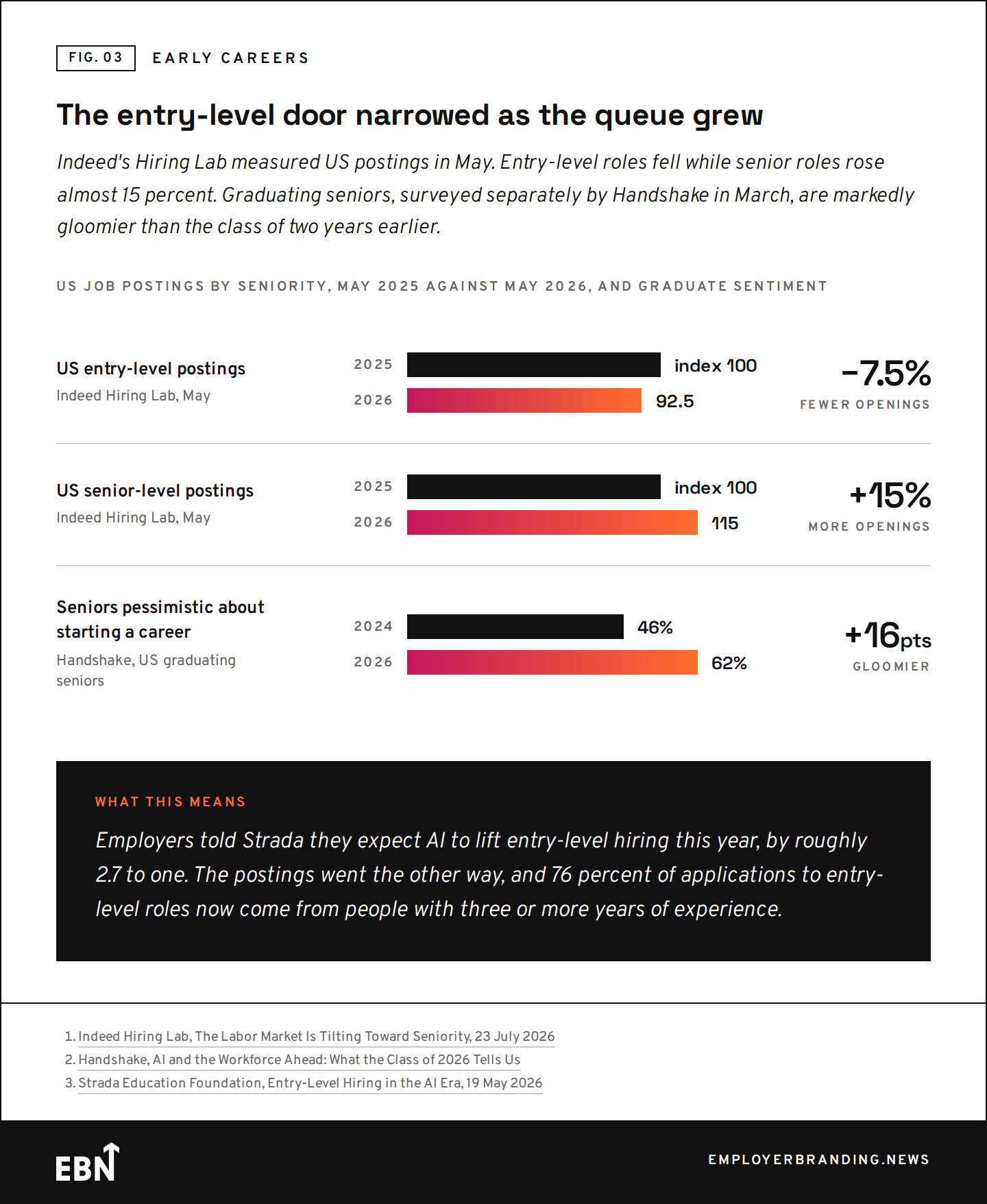
The postings data also suggests the shift is already happening, in a direction McKinsey does not describe. PwC's AI Jobs Barometer, published on 18 June and built on more than a billion job adverts, found that in the most AI-exposed occupations, 52 percent of the new skills appearing in entry-level postings were ones historically associated with experienced workers. In the least exposed occupations it was 7 percent. Redrawn openings of that kind are up 35 percent since 2019. Traditional entry-level openings are down 10 percent.
Demanding judgment at the point of entry is not the same as building it. It moves the cost onto the candidate, the university, or whichever employer trained them first.
Indeed's Hiring Lab shows what that does to the queue. Entry-level postings in the US were down 7.5 percent in May year on year, while senior-level postings rose almost 15 percent. Of the applications going to entry-level roles, 76 percent came from people with three or more years of experience and 30 percent from people with ten or more. "For job seekers new to the labor force," the Hiring Lab economist Felix Aidala said, "competition from more experienced workers may make it even more difficult to stand out in a crowded field of qualified candidates."
Bank of America, the article's main worked example, illustrates the same thing from the employer side. It is bringing in nearly 4,000 interns and campus recruits from more than 500 schools, holding its numbers flat and redesigning the roles around AI, which is more than most large employers are doing. Business Insider reported on 3 June that the bank received around 240,000 applications for fewer than 2,000 internship places, an acceptance rate of roughly 0.8 percent. The pipeline is the same width. The queue outside it got much longer.
Codifying the thing that resists codification
The foundation McKinsey puts under all of this is knowledge management: capture how top performers think, structure it so language models can reach it, weight accumulated judgment above isolated experience.
Anyone who lived through the first knowledge-management wave will recognise the shape of that promise. The theoretical objection is older still. Michael Polanyi, whose distinction between tacit and explicit knowledge the whole field rests on, wrote in 1969 that "the ideal of a strictly explicit knowledge is indeed self-contradictory." The codifiable residue is not the expertise.
The practical objection is that most organisations are nowhere near the starting line. Cisco's AI Readiness Index, based on 8,039 senior leaders across 30 markets, found 24 percent of companies reporting clean, centralised, AI-ready data. Cisco sells AI infrastructure and has an interest in a readiness gap, so treat that as directional. Gartner, surveying 1,203 data management leaders, found 63 percent either lacking the right data practices for AI or unsure whether they had them.
One question nobody in this debate has answered with data, EBN included: the people whose judgment is to be codified are the people whose scarcity makes them valuable. No published research EBN could find measures whether they are willing to hand it over.
What this means for employer brand
Here is where the argument lands for anyone who has to sell an early-careers programme.
What graduates say they want has not moved. In Handshake's UK survey of 10,678 students and graduates, the most-cited priority for a first role was learning skills at 31.7 percent, followed by career progression at 26.6 percent and mentorship at 16.5 percent. Roughly three-quarters of stated preference is development-shaped. Salary came fifth.
Now read the redesigned role back to that audience. Working with, supervising and improving AI output is, in the daily experience of it, quality control on machine drafts. There is early evidence about how that feels. Research by BetterUp Labs with Stanford's Social Media Lab, surveying 1,150 US full-time employees and published by Harvard Business Review in September, found 40 percent had received AI-generated work of no real use in the previous month, spending an average of one hour 56 minutes dealing with each instance. Half thought less of the sender's capability. Forty-two percent trusted them less.
A role built around checking machine output places a graduate permanently next to that hazard, on someone else's work, at the exact career stage when their reputation is being formed. That is a real employer value proposition problem and it is not solved by a page on the career site.

A professional home for employer branding. The Institute of Employer Branding Professionals is being built and you can help shape it.
The pipeline risk cuts the other way too. Handshake put pessimism about starting a career among graduating US seniors at 62 percent, up from 46 percent two years earlier. Three-quarters of the pessimists cited fewer entry-level roles (one option among seven in a multi-select, so read it as the most common reason rather than the reason). Strada Education Foundation surveyed 1,498 executives in March. More of them expect AI to increase entry-level hiring in 2026 than to decrease it, by roughly 2.7 to one. In the same survey, 33 percent said AI had already cut the foundational, skill-building tasks juniors learn from.
Both things are true at once. Employers intend to keep hiring juniors and have already removed the work that used to train them. Nothing in the intent data closes that gap, and an employer brand that promises development while the mechanism is unfunded is writing a cheque against the graduate's third year.
The awkward part
The four-part programme, taken seriously, is a multi-year data and management transformation. McKinsey sells those. That is no reason to dismiss the argument, and the firm's own HR Monitor supplies some of the most damaging numbers in this piece, which is to its credit. It is a reason to read the prescription as a scope document as well as an argument.
Two smaller things for anyone citing the article. The recent-graduate unemployment figure is given as roughly 5.7 percent; the NY Fed release it cites reported 5.6, and neither number means much without the 4.2 percent rate for all workers or the 7.2 percent for same-age people without a degree. And McKinsey says Yale's Budget Lab flags a divergence between younger and older graduates as consistent with early-career effects. That claim does not appear in the tracker EBN read, whose April version reports no substantial change in the occupational mix for recent graduates against older peers.
None of that unmakes the diagnosis. The apprenticeship channel is being disrupted, whatever replaces it will have to be designed rather than inherited, and Hancock and Seiler are asking the right question in public while most employers are not asking it at all.
Their design has one testable assumption at its heart: that a person who cannot yet do the work can learn from a machine's version of it, with a manager to referee. Everything measured so far says the first half of that is where skill goes to die, and the second half is the resource employers have spent three years deleting.
So the question for anyone building an early-careers programme this autumn is narrower than the article implies. Redesigning the roles is the easy half. The test is whether the coaching hours have a name, an owner and a line in someone's objectives. And what the graduate gets told, honestly, about which half is funded.
Takeaways
What does McKinsey's "answer key" model for entry-level work actually propose?
In its July 2026 Quarterly article, McKinsey proposes that a junior employee attempts a task first, an AI system grades the attempt, and the employee then reviews the differences with a manager. It sits alongside three other recommendations: codifying expert knowledge for AI systems, redesigning entry-level roles around supervising AI output, and upskilling managers as coaches.
Is there evidence that comparing your work against AI output builds skill?
Not yet, on the studies McKinsey cites. The two physician trials it relies on measured performance only while the AI was in hand, with no retention or transfer test, and neither tested a compare-and-reconcile workflow. In the JAMA Network Open trial, GPT-4 alone scored a median 92 percent while the physicians using it scored 76.
Can inexperienced workers effectively supervise AI output?
The evidence is discouraging. A 2024 Nature Human Behaviour meta-analysis of more than 100 experiments found human-AI combinations performed on average worse than the best of human or AI alone, with the largest losses on decision tasks and in cases where the AI outperformed the human. That is the novice-plus-strong-model configuration.
Does AI-assisted practice help or harm learning?
Both, depending on design. A randomised trial of 480 BCG consultants found large gains with the tool and none once it was removed. In a study of close to a thousand Turkish high-school students, a standard chatbot cut unassisted exam scores by 17 percent, while a purpose-built tutor removed the harm without producing a learning gain.
Do managers have time to coach juniors through AI output?
Little of it. Gallup puts average direct reports at 12.1 in 2025, up from 8.2 in 2013, with 97 percent of managers also carrying individual-contributor work and the median manager spending 40 percent of their time on it. McKinsey's own HR Monitor 2026 found more than half of employees receive feedback once a year or never.
Are employers really hiring for judgment instead of specialisms?
The precedent says be sceptical. When employers removed degree requirements, Burning Glass Institute and Harvard research across 11,300 roles found the net effect on hiring was 0.14 percentage points, fewer than one in 700 hires. Forty-five percent of firms changed the wording and nothing else.
Is entry-level hiring actually falling?
The signals conflict. US entry-level postings were down 7.5 percent year on year in May while senior postings rose almost 15 percent, according to Indeed's Hiring Lab, and 76 percent of entry-level applications came from people with three or more years of experience. Employer intent surveys, including Strada's, remain more optimistic than the postings data.
What is the employer brand risk in redesigning entry-level roles around AI?
Graduates still rank learning skills, progression and mentorship as their top priorities for a first job, at 31.7, 26.6 and 16.5 percent in Handshake's UK survey. A role built around reviewing machine output sits close to a known reputational hazard: BetterUp and Stanford research found 40 percent of workers received low-quality AI work in a month, and half thought less of the sender's capability.
Was Bank of America's 2026 intake an expansion?
No. The bank held its numbers roughly flat at nearly 4,000 interns and campus recruits from more than 500 schools while redesigning the roles around AI. Business Insider reported around 240,000 applications for fewer than 2,000 internship places, an acceptance rate of about 0.8 percent.

Employer branding works better when people share what they know. EBClub brings practitioners together to exchange ideas, compare experiences, and learn from the people doing the work.
SOURCES
| # | Source | Publisher | Used for |
|---|---|---|---|
| 1 | Building expertise in the age of AI: Who trains the next generation? | McKinsey Quarterly, 14 July 2026 | The article under review. The four-part prescription and the answer-key quote (“The employee attempts first, the AI grades the attempt”); the “general athlete” framing; Exhibit 1 (49% not occurring, 8% many or most, New Era of Work Survey, Sept 2025, n=28,000, methodology unpublished); Exhibit 2’s own “directional only” note; the 5.7% unemployment figure and the unverified Budget Lab attribution. |
| 2 | Canaries in the coal mine? Six facts about the recent employment effects of artificial intelligence | Stanford Digital Economy Lab, 13 Nov 2025 | The 16% relative employment decline for workers aged 22 to 25 in the most AI-exposed occupations, as cited by McKinsey. ADP payroll data; the authors frame the result as consistent with the AI hypothesis rather than as causal identification. |
| 3 | Remote work leaves younger workers sidelined The labor market for recent college graduates |
Federal Reserve Bank of New York, 1 June 2026 and Q1 2026 update | Emanuel, Harrington and Pallais on remote work as a rival explanation for young-graduate unemployment (they put it at 64% of the recent rise). Separately, the 5.6% recent-graduate unemployment rate McKinsey rounds to 5.7, plus the 4.2% all-worker and 7.2% same-age non-graduate comparators the article omits. |
| 4 | Tracking the impact of AI on the labor market | The Budget Lab at Yale, updated 15 June 2026 | The null finding McKinsey cites: “Measures of AI usage show no connection to changes in employment or unemployment.” Also checked for, and could not find, the young-versus-older graduate divergence McKinsey attributes to this tracker; the April 2026 version reports no substantial change in occupational mix for recent graduates against older peers. |
| 5 | Redefining the software engineering profession for AI Microsoft leaders warn of a junior developer pipeline crisis |
Communications of the ACM, April 2026; InfoQ, April 2026 | Russinovich and Hanselman’s “AI boost” and “AI drag” framing, and the preceptor model. The detail that mentorship should be measured and compensated as a primary deliverable comes via InfoQ’s summary; the ACM original is paywalled and this is flagged in the copy. |
| 6 | Large language model influence on diagnostic reasoning: a randomized clinical trial GPT-4 assistance for improvement of physician performance on patient care tasks: a randomized controlled trial |
JAMA Network Open, Oct 2024; Nature Medicine, Feb 2025 | The two trials McKinsey rests the answer-key model on. JAMA: 50 physicians, 244 cases, median 76% with GPT-4 against 74% without (adjusted +2pp, p=0.60), GPT-4 alone 92%, and participants “not forced to use the system in any consistent way”. Nature Medicine: 92 physicians, +6.5pp on management reasoning. Neither measured retention or transfer; neither tested a compare-and-reconcile workflow. |
| 7 | When combinations of humans and AI are useful: a systematic review and meta-analysis | Nature Human Behaviour, 2024 | Vaccaro, Almaatouq and Malone. More than 100 experiments and over 300 effect sizes: human-AI combinations on average “performed significantly worse than the best of humans or AI alone”, with losses concentrated in decision tasks and in cases where the AI outperformed the human. |
| 8 | AI teaches surgical diagnostic reasoning to medical students | Journal of Surgical Education, Oct 2025 | Kıyak et al., McKinsey’s second learning-science citation. Not randomised; 38 first-year students against 33 second-years from a different cohort at a single university in Ankara; five abdominal conditions; five-day intervention with a two-week follow-up. Fully automated, no human in the loop. |
| 9 | GenAI as an exoskeleton: experimental evidence on knowledge workers using GenAI on new skills New Future of Work Report 2025 |
SSRN working paper, 2024; Microsoft Research, Dec 2025 | Wiles et al.: 480 BCG consultants scored 49, 20 and 18 percentage points above control with GPT-4 and no better without it afterwards. Microsoft’s report is the route by which McKinsey cites it, for the line that “the capability vanished the moment AI access was removed”. Working paper, not peer reviewed, and run with the firm studied. |
| 10 | Generative AI can harm learning | Working paper, 2024 | Bastani et al. Close to a thousand Turkish high-school students across four maths sessions: a standard chatbot cut unassisted exam performance by 17%, and a safeguarded tutor version built to withhold answers removed the harm while producing no learning gain. |
| 11 | Shadow learning: building robotic surgical skill when approved means fail Matt Beane interview |
Administrative Science Quarterly, 2019; EO Magazine, 13 July 2026 | Beane, whose book McKinsey cites approvingly. The robotic-surgery fieldwork: residents got ten to twenty times less hands-on practice, the ones who built skill broke norms to reach the controls, and the approved path produced “helicopter teaching”. The 2026 interview supplies the “free B-plus content” quote. |
| 12 | Span of control: what’s the optimal team size for managers? | Gallup, 2025 | Average direct reports per manager at 12.1 in 2025 against 8.2 in 2013; 97% of managers also carry individual-contributor work; the median manager spends 40% of their time on it; 13% oversee 25 people or more. Analysis of 16,442 managers. |
| 13 | HR Monitor 2026: a turning point for the people function | McKinsey & Company, 8 June 2026 | McKinsey’s own survey, used against its own prescription: 24% of employees report no training participation at all; more than half receive feedback once a year or never; 11% of organisations take a long-term view of workforce planning. Roughly 1,300 HR professionals and 5,500 employees across ten countries. |
| 14 | Gartner HR survey reveals 45% of managers report AI has lived up to their expectations Lack of AI-ready data puts AI projects at risk |
Gartner, 4 March 2026 and 26 Feb 2025 | The 7% of organisations that give any guidance on how time saved by AI should be used (survey of managers, employees and HR leaders). Separately, 63% of organisations either lack the right data practices for AI or do not know whether they have them, from 1,203 data management leaders. |
| 15 | Skills-based hiring: the long road from pronouncements to practice | Burning Glass Institute and Harvard Business School, Feb 2024 | The precedent for the “general athlete” recommendation. Across 11,300 roles at large US firms, 2014 to 2023, dropping the degree requirement raised non-degree hiring 3.5pp in those roles but moved all hiring by 0.14pp, fewer than one in 700 new hires. 45% of firms changed the wording and nothing else. |
| 16 | Entry-level jobs are getting ‘seniorized’, PwC finds | PwC 2026 AI Jobs Barometer, via Fortune, 18 June 2026 | In the most AI-exposed occupations, 52% of new skills in entry-level postings were historically associated with experienced workers, against 7% in the least exposed; seniorized openings up 35% since 2019 and traditional entry-level openings down 10%. Built on more than a billion job adverts. PwC is itself one of the firms that cut UK graduate intake last year. |
| 17 | The labor market is tilting toward seniority Workers with 10-plus years’ experience applying for entry-level roles |
Indeed Hiring Lab, 23 July 2026; syndicated coverage 24 July 2026 | US entry-level postings down 7.5% in May year on year against senior-level up almost 15%; 76% of entry-level applications from people with three or more years of experience, 30% from ten or more; the Felix Aidala quote. hiringlab.org blocks automated fetching, so figures come from the syndicated version, which is flagged in the copy. |
| 18 | BofA to welcome nearly 4,000 summer interns and campus recruits Bank of America accepted less than 1% of internship applicants this year |
Bank of America, 3 June 2026; Business Insider via Yahoo Finance, 3 June 2026 | Nearly 4,000 interns and campus recruits from more than 500 schools, flat year on year. Against that, around 240,000 applications for fewer than 2,000 internship places, an acceptance rate of roughly 0.8%. Used to show the pipeline held its width while the queue lengthened, which is the opposite of how the figure usually gets quoted. |
| 19 | Knowledge management, codification and tacit knowledge | Information Research 18(2), 2013 | Kimble, and through him Polanyi’s 1969 line that “the ideal of a strictly explicit knowledge is indeed self-contradictory”. Also the point that codebook maintenance costs recur and that codifying part of a body of knowledge causes the uncodified remainder to be discounted. |
| 20 | AI Readiness Index 2025 | Cisco, Oct 2025 | 24% of companies report clean, centralised, AI-ready data, from 8,039 senior leaders across 30 markets. Vendor-published by a company that sells AI infrastructure and has a commercial interest in a readiness gap, which is stated in the copy. |
| 21 | 2026 network trends: student and graduate hiring survey (UK) AI and the workforce ahead: what the Class of 2026 tells us about the future of the labor market |
Handshake, 2026 | First-role priorities among 10,678 UK students and graduates: learning skills 31.7%, career progression 26.6%, mentorship 16.5%, meaningful work 9.6%, salary 8.2%. Separately, US graduating seniors pessimistic about starting a career at 62% against 46% two years earlier, with fewer entry-level roles the most-picked of seven multi-select reasons at 75%. |
| 22 | AI-generated ‘workslop’ is destroying productivity | BetterUp Labs and Stanford Social Media Lab, via Harvard Business Review, 22 Sept 2025 | 40% of 1,150 US full-time employees received AI-generated work of no real use in the previous month, spending an average of one hour 56 minutes on each instance; 50% viewed the sender as less capable and 42% as less trustworthy. Used for the reputational hazard sitting next to a supervise-the-AI role. |
| 23 | Entry-level hiring in the AI era: what employers are thinking (and doing) | Strada Education Foundation, 19 May 2026 | 1,498 US executives and senior talent leaders, fielded 3 to 22 March 2026: more expect AI to increase entry-level hiring in 2026 than to decrease it, by roughly 2.7 to one, while 33% say AI has already reduced the foundational, skill-building tasks juniors learn from. Stated expectations, not realised hiring. |