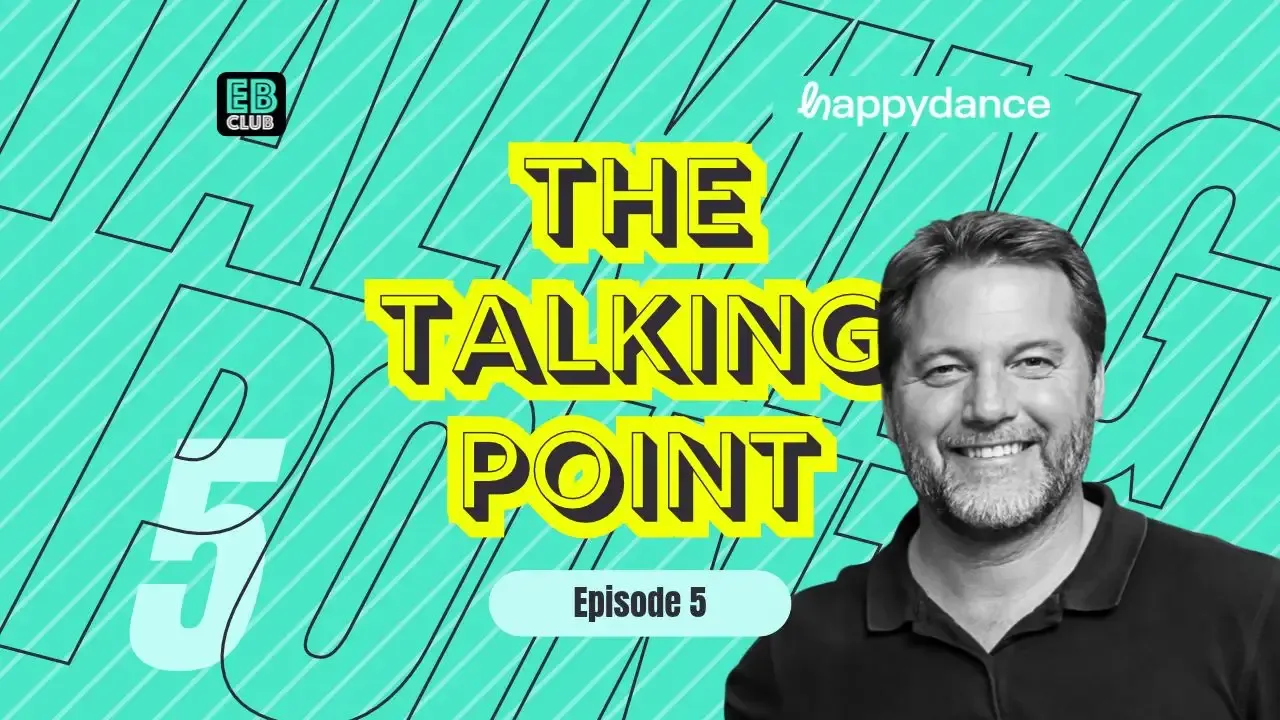
Welcome to the fifth Talking Point. I think. I opened the recording by saying "the fifth, I think", which tells you everything about my wonderful crazy EBClub schedule. Five episodes in and I'm still counting on my fingers.
This one asked a question I've been chewing on for a while. A few years ago, inclusion was right at the top of every EVP brief, every employer brand strategy, every agency RFP. Then, somewhere along the way, it went quiet. So did we forget to include inclusion in employer branding? Or did we just get better at it, so it stopped needing a banner? I wanted to talk it through with someone who really cares about it.

Your employees know the truth. Does your EVP? At Fathom we measure the "Credibility Gap" between your promise and their reality.
A massive thank you to Chloe
Chloe Burri is an employer branding and talent attraction specialist who spent several years at BT, joining on the HR graduate scheme and finding her way into employer branding on a rotation. As she put it, they probably thought, "She's young, she'll want to do social media." They were right, and she fell in love with it. She had studied anthropology, so her passion for fairness and inclusion goes back long before her first careers post.
When Chloe suggested inclusion as a subject on the EBClub platform, I said yes straight away. Anyone who knows me knows I want people on these sessions to talk about the thing they care most about, because that's when you get the good stuff. And Chloe delivered. Thank you, Chloe. Generous, honest and full of practical examples.
We keep tracking to a minimum. The video is hosted on YouTube, which may place cookies that measure viewing and personalize content. We only load the player after you consent to these cookies. You can update your cookie settings any time.
Attraction is the easy part. The experience has to back it up
Chloe's proudest project at BT was a return-to-work programme, built with Career Returners (formerly Women Returners). It was aimed at skilled professionals who'd been out of work for at least 18 months, often for caring or health reasons. One person in the first cohort had been out of the corporate world for 20 years. They're exactly the CVs that typically end up on the scrap heap, because an employer sees a gap and assumes the skills have gone.
The attraction worked brilliantly. One post that leaders shared in their own words reached around 70,000 impressions, and BT hired 18 people in the first cohort. But the bit I loved was everything after the click. There was an interview pack for people who hadn't done a competency interview in years, an FAQ drop-in, hiring managers briefed on handling career breaks sensitively, and job ads stripped of jargon and acronyms. Even a Microsoft Teams walkthrough before the interview. Then a proper four-week induction, the kind graduates get but experienced hires usually don't, with the HR director there on day one and a session with the CEO.
Chloe's point: there's no use attracting people from different backgrounds if the process and the job don't support them once they're in. It's the same gap we wrote about in employer branding's catfishing problem, and it's a reminder of how many good people are being overlooked. See also Too Old to Hire. Too Young to Retire.
When every company sounds the same, be specific
Chloe nailed why inclusion went quiet. It's now in every job ad and on every careers site, so it doesn't differentiate anyone. "We welcome people from all backgrounds." "Bring your authentic self." Lovely, but every company says it. What candidates want now is the specifics. What's your parental leave, and is it equal for men and women? What's the process for adjustments, at interview and in the job itself? Won an award? Tell me what it was for. Don't just say you have an ERG, tell us what they achieved and how they empower.
She made a sharp point about badges, too. Some schemes are partly self-assessed, so the question is whether you're displaying a badge because it looks good or because you can follow through on the promise. I'd add legitimacy to specificity (yes, I managed to say it properly this time). A claim has to be shown. Nobody believes a slogan any more. Mike Parsons made a similar case recently in Not Everything Is a Story: it comes down to proof.
And here's the bonus. As we learned with both Martin Lehnert & Bryan Adams in recent episodes, being specific helps AI search too. LLMs aren't going to cite "we value belonging". They will cite a clear flexible working policy, or a dad talking about his equal parental leave, or someone who was promoted while on maternity leave.
Employer branding works better when people share what they know. EBClub brings practitioners together to exchange ideas, compare experiences, and learn from the people doing the work.
Advocacy, without the tokenism
Employee advocacy has done a lot to democratise the message. But I asked Chloe something I know people worry about: what if the people you most want to hear from feel vulnerable sharing their story? Her answer was simple. You can't force it. Start with the people who want to share. The returner who'd been out of work for 20 years chose to tell her story to help promote the second cohort, including the rejections and the recruiter who made all the difference.
Not every story has to be personal, either. People can speak about fairness because they see it around them and believe in it, value it. Plenty of people I've worked with have told me they don't want to be the token, or the poster-child for inclusion. They want to be seen as being empowered to be high performers, full stop - regardless of their characteristics - that fairness exists across the work culture. On the subject of tokens, Chloe added that content for Black History Month or International Women's Day is great, but are you telling and living those stories all year round? There's more on doing advocacy well in our piece on employee generated content.
The small details that quietly shut people out
This was the bit that made me sit up. Employer brand doesn't own every part of the hiring process, but candidates experience it as one thing. Still asking for salary history? That disadvantages people who've historically been underpaid, often women and people from ethnic minority backgrounds. Telling candidates to email for adjustments? Brilliant, as long as somebody actually replies.
Flexibility came up again and again. Chloe worked with Flexa at BT, and their data shows that simply saying you're open to flexible working can widen your talent pool. For a carer or someone with a health condition, a five-day office mandate can be the difference between working and not. Worth remembering while the return-to-office whiplash carries on.
Who's getting it right
Chloe brought some lovely examples, and plenty of them come from charities and the public sector:
- Macmillan Cancer Support has a careers video with British Sign Language and a full adjustments pack showing what the interview looks like, the types of questions and the adjustments available, plus a second pack on adjustments in the role itself.
- TUI shares interview questions in advance, which helps neurodivergent candidates and makes everyone more prepared. Inclusive as standard, no need to ask.
- Alzheimer's Society offers screen reader functionality, which made us both wonder whether employer branding does enough to make careers sites and content accessible.
- Vizzy is replacing the CV in early careers with a fuller profile: projects, and even the questions candidates would love to be asked. Chloe's view is that experienced hiring could learn a lot from early careers here. It's a timely thought given how tough the graduate on-ramp has become.
She also pointed to BT reskilling contact centre colleagues with no technical background into accredited cybersecurity roles. That's the ultimate employer branding proof point. Which brings me to where we landed: you can't use specificity if there's nothing specific to talk about. Employer branding tells the great stuff about great businesses. The great stuff has to exist first.
So, yes we haven't forgotten inclusion, we are to a greater extent, clearly getting better at its natural place. Our evolution towards advocacy, culture and employee experience focus hasn't come by accident; across the board the clamour for truth over slogan in employer brand means you can't fake experiences anymore, but also with products like Vouch, our employer brand communications and hence our inclusion signals, can come straight from the mouths of employees. An act of inclusion in itself.
Thank you, everyone in the room
Thank you to everyone who joined live and everyone catching up now. It was a quieter one for questions, so if this sparked something, and I hope it did, bring it into the EBClub community or the YouTube comments. These are exactly the conversations we should be having. Neither of us claims to have all the answers, and that's the point.
EB Club is flying
I keep having to pinch myself. EBClub is easily the fastest growing community of employer branding professionals in the world, and the diary is bonkers. Before the end of the year we're in Paris, Rotterdam and London. January brings Manchester. February takes us to Berlin and Krakow, then across the Atlantic to Boston and New York. Check the events listing for one near you. If you work in-house in employer branding, talent attraction, TA or HR and you're not in yet, you're missing the best conversations in the industry, in person and online.
It's free for in-house practitioners, and applications are reviewed within 48 hours, usually much quicker.
Next time: two global EB leaders
In two weeks I'm joined by Heather Walker of SAP and Rhian Kiernan, until recently at Haleon. Two global employer brand leaders on how AI is changing what it means to lead an EB team: how you structure it, grow it and manage people when the landscape moves this fast. It's going to be a cracker.
Catch up on episode one on GEO, episode two on candidate trust, episode three on humour and episode four on storytelling and careers sites.
Thank you again, Chloe. See you in two weeks.
Steve
Explore EBClub
Find upcoming events, meet the people shaping the community, join the conversation or learn how to support EBClub as a partner.
| EBClub | What you will find | Explore |
|---|---|---|
| About EBClub | Learn how EBClub connects employer branding practitioners through peer learning, discussion and shared experience. | Explore EBClub |
| Events | Browse upcoming EBClub gatherings, panels and practitioner-led sessions around the world. | View events |
| People | Meet the practitioners, ambassadors and contributors supporting the EBClub community. | Meet the community |
| Join EBClub | Connect with employer branding professionals sharing ideas, testing approaches and learning together. | Join EBClub |
| Partner with EBClub | Support practitioner-led events, industry discussion and wider access to employer branding knowledge. | Explore partnerships |