


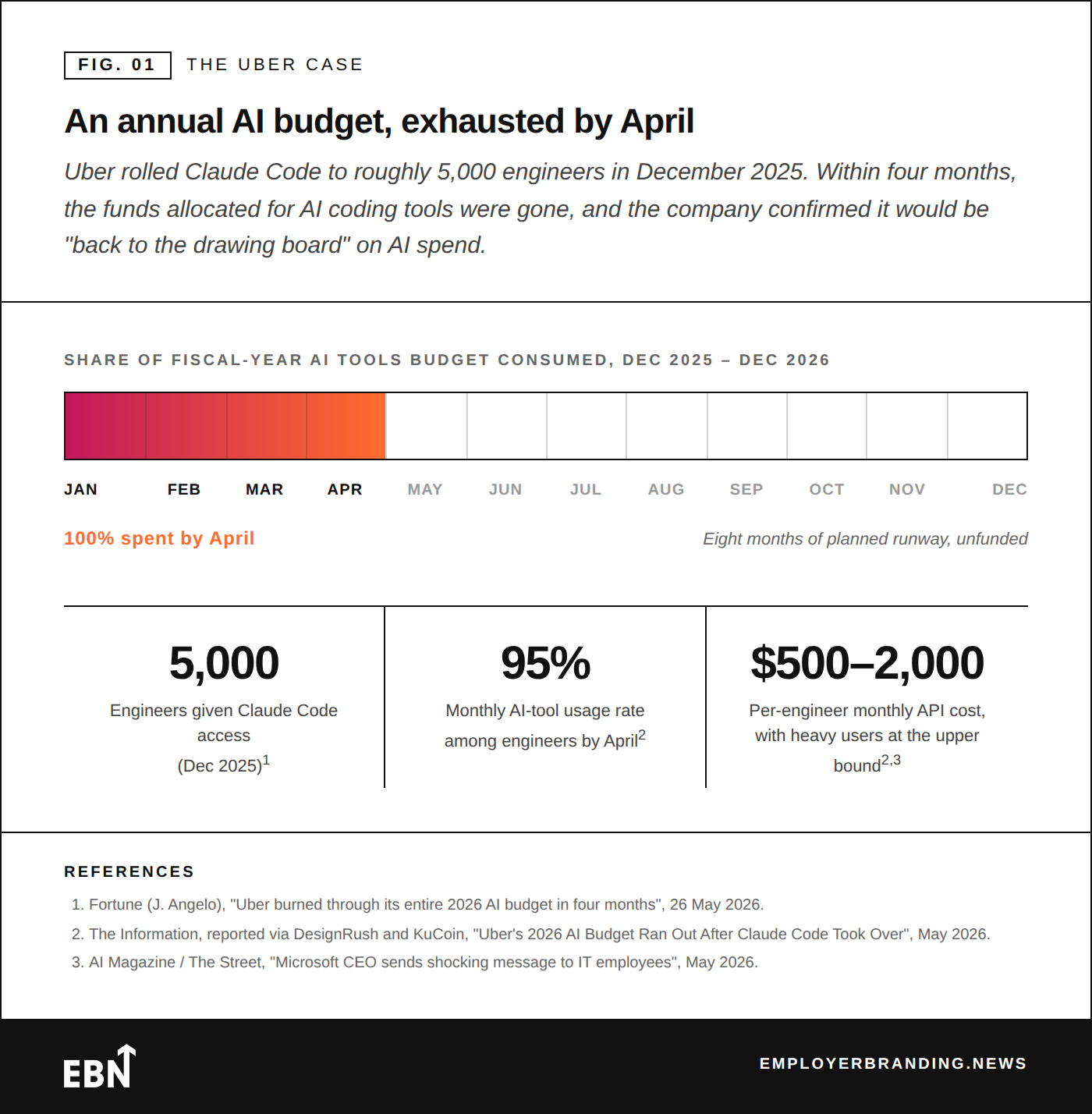
Uber gave 5,000 engineers access to an AI coding tool in December 2025. By April 2026 - just four months later - the company had burned through its entire annual AI budget. Not 50% of it. Not 75%. Every single dollar. Gone before summer.
The tool in question was Claude Code, built by Anthropic. The same Anthropic whose CEO Dario Amodei spent the first quarter of 2026 warning enterprises that AI would wipe out half of all entry-level white-collar jobs. The same Anthropic valued at almost $950 billion on the strength of an enterprise pitch built around the idea that AI would make corporations more cost efficient by making the humans optional.

Your employees know the truth. Does your EVP? At Fathom we measure the "Credibility Gap" between your promise and their reality.
It turns out AI also makes budgets optional. And that is a problem that HR and talent acquisition teams have not yet begun to reckon with.
The Meter Is Running
Here's a scary sentence that should be pinned above every CFO and CHRO's desk in 2026.
Sam Altman told an interviewer in March: "We see a future where intelligence is a utility, like electricity or water, and people buy it from us on a meter."
Not a licence or a seat, a meter. The same model your energy provider uses. The same model that has produced some of the largest utility bills in corporate history when consumption runs ahead of forecast. And we all know what's been happening to energy bills recently.
This is the detail that got buried under two years of human replacement narrative. While the token salesmen - Altman, Amodei, and the enterprise sales teams behind them - were selling the efficiency revolution to employers, they were also quietly shifting their pricing models from flat subscriptions to usage-based token consumption. Every prompt, document, and AI-assisted decision... metered and charged.
That fancy new AI model that's smarter than the one it just superseded... yeah, it's WAY more expensive, too. Most don't know.
The labour replacement promise was the pitch - it meant incredible cost savings leading to dreamland profits. The meter is now the business model. And the meter does not care whether headcount went up or down.
FIGURE 1 - Uber budget burn
What Bill Shock Actually Looks Like
The Uber case is the most dramatic public data point so far, but it is far from unique.
One healthcare enterprise consumed 1 trillion tokens over six months, generating more than $6 million in unplanned costs before the finance team even understood what was driving the invoices. A developer at another company left an AI coding agent running overnight and woke up to a $6,000 charge for a single session. Another hit $4,200 in API fees over a single weekend.
I recently caught up with a good friend from a top tier professional services firm who told their first bill from Anthropic was almost TEN TIMES what they'd expected it to me. It was millions in unplanned costs but I doubt the bill shock story will go public.
These are not mere rounding errors. These obscene bill shocks are a consequence of a pricing model that most procurement teams did not read carefully enough when they signed the contracts. And even if they had, the AI hype train would have probably seen the contracts signed anyway.
The average organisation's OpenAI API spend reached $384,500 annually as of April 2026 - and AI-native application spend grew 108% in 2025 alone. 78% of IT leaders recently surveyed reported unexpected charges tied to consumption-based AI pricing models. Not a minority experience or fringe cases, but nearly four in five being caught out with bigger than expected bills.
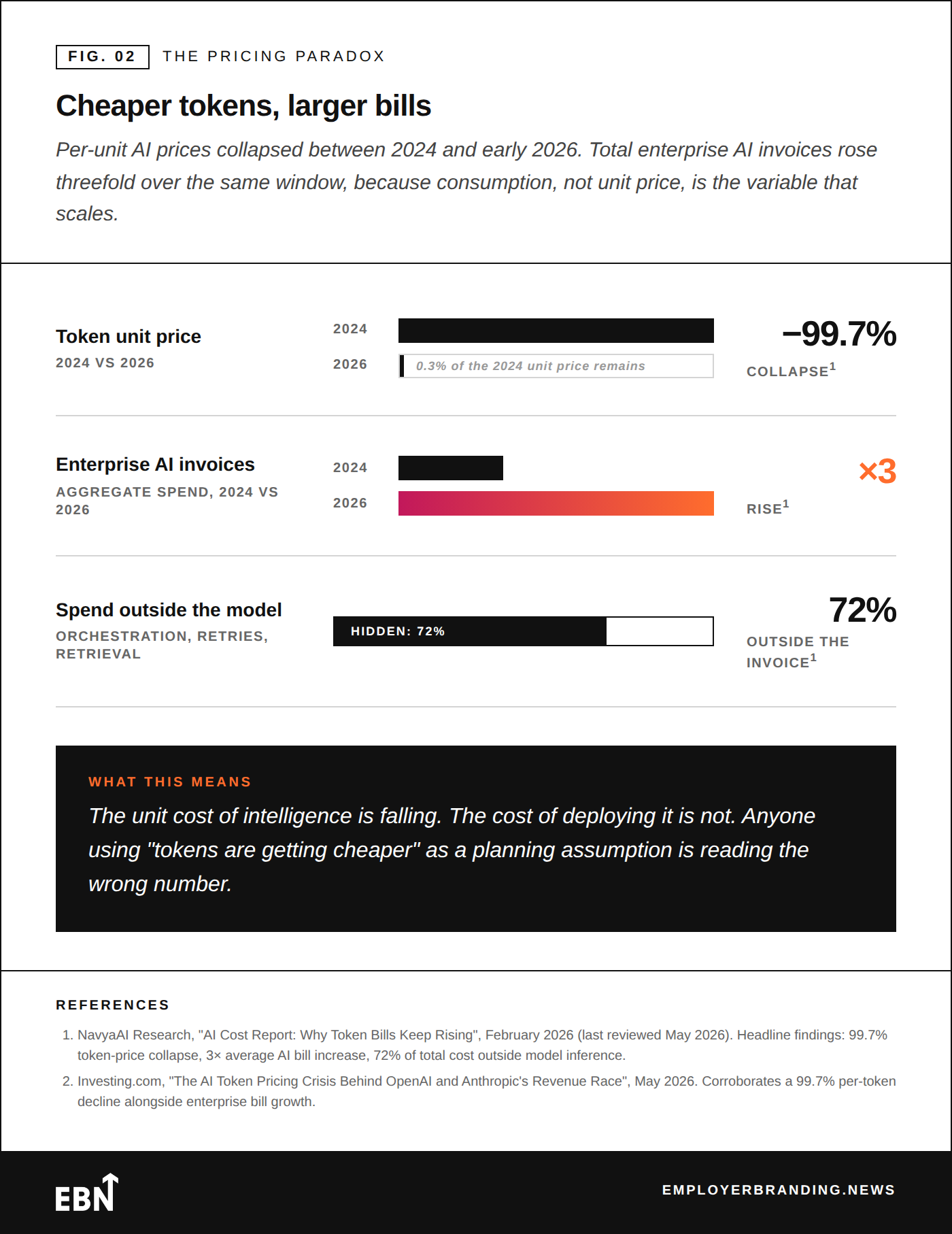
The reason isn't user error and nobody could blame the employees who're being pushed to use the tools more and more - the cost mechanisms are baked into the tools and aren't transparent. Enterprise AI deployment audits consistently find that retry logic, context window management, and retrieval augmentation add between 40% and 60% on top of the token costs most teams are tracking. The bill that surprises most enterprises isn't the one from launching AI. It's the one from running it every day.
GitHub Copilot, the dominant AI developer tool, is moving its entire pricing model to usage-based billing on 1 June 2026. One developer reported their projected monthly cost rising from around €67 in April to roughly €966 under the new model. That's just one lone developer.
Token consumption across enterprise has increased 13x since January 2025. That's an insane increase in little over a year. And, you guessed it... budgets haven't followed the 13x increase during the same time.
FIGURE 2 - The pricing paradox
The HR and TA Exposure
Of course, this isn't just a tech story, it's a human capital story too. After all, the AI is here to supposedly replace expensive human labour, or at very least make it more efficient.
The assumption baked into most enterprise AI investment decisions - and certainly into most HR and TA technology roadmaps for 2026 - was that AI would reduce costs. That is the pitch that was made and the pitch that was believed. Josh Bersin's April 2026 analysis projects 30 to 40% of existing HR roles can be automated, a finding that was used in many organisations to justify both the AI investment and the headcount reduction that preceded it.
What nobody modelled with any rigour was the consumption cost of actually running those AI systems at scale. The pilots were cheap but normal usage isn't. And the gap between the two is why so many CIOs and CFOs are now in a state of shock.
The data is now highlighting the gap directly. Gartner's May 2026 analysis found that roughly 80% of organisations report workforce reductions tied to AI, yet the same organisations cannot demonstrate ROI from those reductions. Gartner also forecasts that more than 40% of agentic AI projects will be cancelled by the end of 2027, citing escalating costs and unclear business value. Separately, the Harvard Business Review summary of Gartner's 2026 research found that only 1 in 50 AI investments delivers transformational value, and only 1 in 5 delivers measurable ROI at all.
Meta, which cut 8,000 employees earlier this year and closed 6,000 open roles specifically to free up budget for AI, is now discovering - as every enterprise will eventually discover - that the AI infrastructure it freed that budget to fund is itself an ongoing, usage-based, non-linear cost. You do not buy AI capability once. You rent it by the token, forever, at a price that rises with every additional use case you deploy it for.

Employer branding now has a measurement standard. The Talent Gravity Standard is a six-driver framework for quantifying employer attractiveness and the gap between brand promise and employee experience.
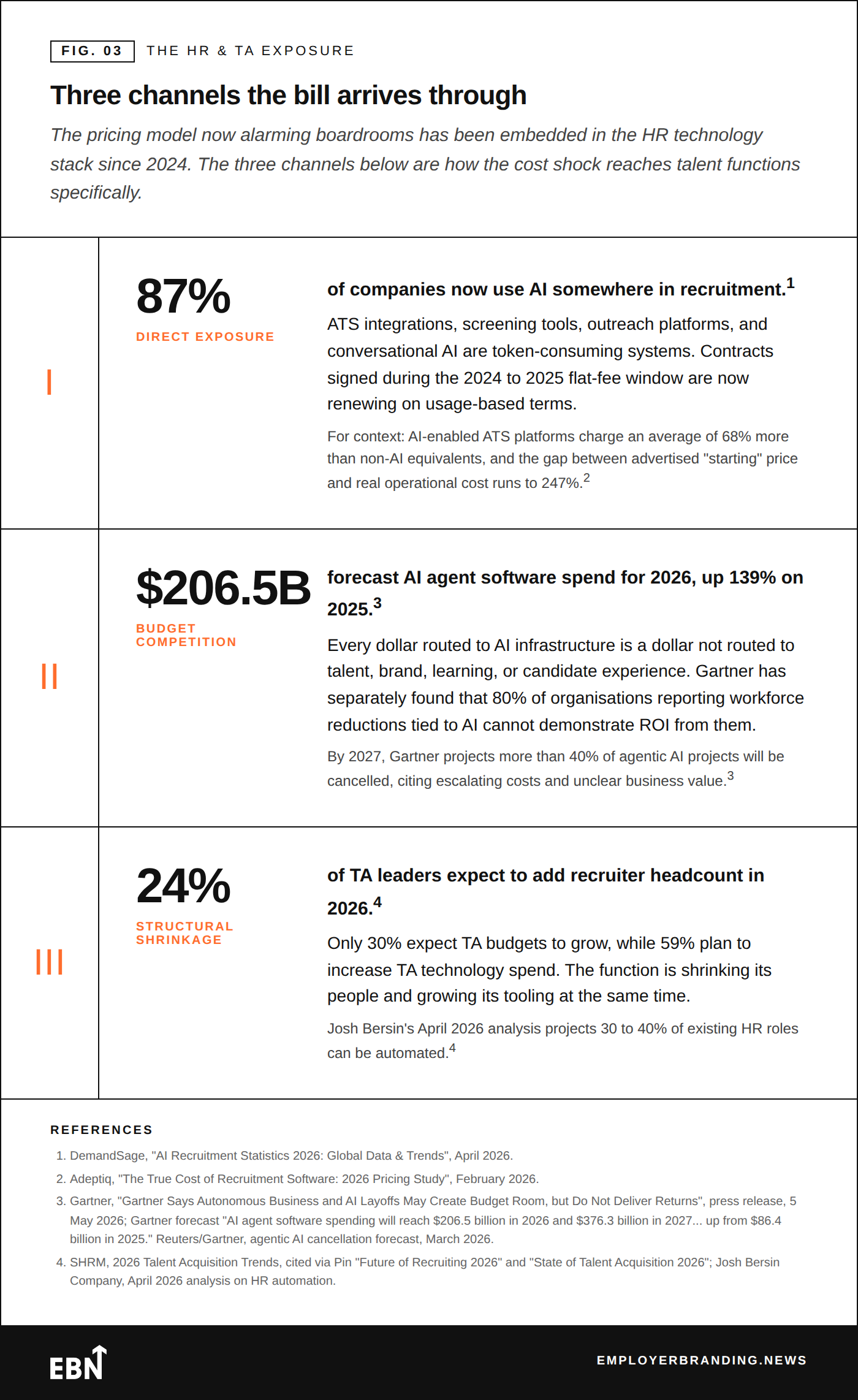
For HR specifically, the exposure arrives through three channels...
The first is direct: the AI tools already deployed in recruitment stacks. ATS integrations, AI screening tools, automated outreach platforms, conversational AI for candidate experience - all of these are token-consuming systems. 87% of companies now use AI in some part of their recruitment process. Most of those contracts were signed during the 2024–2025 experimentation wave. Most enterprise AI contracts were signed when AI pricing was the wild west of flat tiers and generous allowances. Independent ATS pricing research published in February 2026 found that AI-powered ATS platforms charge an average of 68% more than non-AI equivalents, and that the gap between the advertised "starting" price of recruitment software and what teams actually pay in production runs to roughly 247%. Renewal season is arriving and the pricing conversations are going to be different this time.
What should HR teams do - slash the AI spend and rehire the humans or double down on the AI? I know where I'd put my money.
The second is indirect: the budget competition. Every dollar that goes to AI infrastructure is a dollar that doesn't go to talent acquisition, employer brand, learning and development, or any other HR function that requires sustained investment. When Uber's COO explicitly framed the question as a trade-off between AI token spend and headcount, he was naming a choice that CEOs across every industry are running the numbers on. HR teams that have already absorbed headcount reductions justified by AI efficiency will now face a second pressure: the AI itself costs a lot more than projected.
The third is structural: the pivot cost. Only 24% of TA leaders expect headcount increases in 2026. Only 30% expect their TA budget to grow at all. Yet 59% plan to increase TA technology spending. The function is shrinking its people and growing its tooling at the same time, on the assumption that the tooling will deliver the savings (and do the work). When the bill shock forces a budget correction, and it will, the functions that have been allowed to atrophy will face the most painful rebuilds.
FIGURE 3 - Three channels of exposure
The Pitch and the Price
I think it's worth being direct about the connection between the replacement narrative and the cost crisis, because the two are not separate phenomena - they are two acts of the same story.
Act one: the token salesmen sell enterprises on a vision of AI replacing human labour at scale. The efficiency gains are real. The headcount savings are real. The investment is justified. High on AI hype CEOs approve it all. HR teams shrink as a result and recruiting pipelines get paused. The employer brand goes silent.
Act two: the usage bills arrive. Uber's COO, confronted with a full-year budget exhausted in four months, admitted he could not draw a clear line between AI token consumption and useful consumer features shipped. "That link is not there yet," he said. "It's very hard to draw a line between one of those stats and 'Okay now we're actually producing like 25% more useful consumer features.'" The ROI promised in AI sales pitches is proving harder to demonstrate than the very real consumption generating the invoices.
What Uber disclosed - and what dozens of organisations will soon disclose over the next 12 to 24 months (mark my words) - is that the token economy is not a one-time cost of transformation. It is a permanent, escalating, consumption-based operating expense. Gartner forecasts AI agent software spending will reach nearly $207 billion in 2026, up more than 139% from $86.4 billion in 2025. That trajectory does not flatten, it compounds.
Microsoft, which poured $80 billion into AI data centres and embedded Copilot across its entire product line, is now quietly pulling back in several enterprise scenarios - not because the AI doesn't work, but because the bills started to arrive. In a number of real-world deployments, running AI costs more than employing the humans it was supposed to replace. And, as AI models get more sophisticated (and expensive) and usage increases, so will those costs.
If huge swaths of the workforce aren't replaced and the huge cost savings aren't realised in the way they were sold... this could all backfire really badly.

HR has CIPD. Marketing has CIM. Employer branding has nothing. Until now. The IEBP is being established to give the discipline the professional infrastructure it has always lacked.
What Comes Next for Corporate HR?
The bill shock will force a reckoning that the replacement narrative and AI hype-train delayed. And when the reckoning arrives - not as a theoretical risk but as a budget line that the CFO is freaking out over - HR, TA and EB teams will face a moment of uncomfortable clarity and deep regret.
The organisations that eliminated human capability on the promise that AI would substitute for it will discover that the substitution is partial, the costs are ongoing, and the talent they let go has moved on. Rebuilding takes time and budget. And rebuilding requires an employer brand proposition that has, in many cases, been sorely neglected for two years on the assumption that the hiring freeze was permanent. The macro labour pattern underneath this story is not new. It is the same paradox that has shaped every previous wave of automation, and it has rarely produced the lasting headcount savings corporations expect from it.
The organisations that maintained some version of their talent infrastructure - the employer brand, the pipeline, the in-house TA capability - will be better positioned to respond when the reckoning arrives. Not necessarily because they were smarter, but because they were more cautious about betting it all on a pitch that was built by people whose business model requires consumption to grow without limit.
Sam Altman called it a meter because he was describing a utility. Utilities have bills. And the bill, for a great many organisations that moved fast and didn't read the contract or do the maths carefully, is going to be considerably larger than the efficiency savings they were promised when they signed it.
HR didn't create this situation. But HR will be the schmucks that are left to solve it.
TAKEAWAYS
The trillion-dollar pitch only works if humans are replaceable
Augmentation doesn't justify the spend. For enterprises running thousands of employees, "AI and humans" is a cost increase, not an efficiency gain. The only valuation-defensible story is substitution - and that's the story being told in boardrooms, whether it's stated plainly or simply left unrefuted.
Altman and Amodei are saying different things to different rooms
Amodei warns of a white-collar bloodbath. Altman posts about augmenting people. Same technology, same period, publicly contradictory positions. This isn't a philosophical disagreement - it's a messaging strategy. The pitch adjusts to the audience. Enterprises get replacement. Regulators and the public get responsibility.
Both companies are losing money at extraordinary scale
OpenAI is projected to lose $14 billion in 2026 despite $20 billion in revenue. Anthropic burned $5.3 billion in 2024. Neither expects profitability before the end of the decade. They are subsidising their own product to buy market share and sustain a narrative that needs to be believed before it can be proven.
The hiring freeze is a rational response to an irrational pitch
Companies aren't acting stupidly. They heard a credible story, backed by credible money, and did what organisations do when labour costs look reducible - they started reducing them. The paralysis in recruitment and employer branding is the direct downstream effect of a sales narrative that is running years ahead of the evidence.
The data doesn't yet support the replacement event
The Yale Budget Lab found no significant macroeconomic effects from AI on employment through late 2025. The 54,000 AI-attributed layoffs in 2025, while real, are modest against a global labour market of hundreds of millions. The productivity gains are real. The wholesale replacement of white-collar roles is not - yet.
Employer brands that stay active through the freeze will have a significant advantage
However the paralysis ends - gradual normalisation, a financial reckoning, or managed transition - organisations will need to rebuild trust with a candidate pool that spent years being told they might be replaced. The brands that maintained a human proposition through the freeze will be far better positioned than those that went dark and now have to start from scratch.
SOURCES
| # | Source | Publisher | Used for |
|---|---|---|---|
| 1 | Uber's COO says it's getting harder to justify the company's AI spend | Fortune | Uber COO direct quote, $3.4B R&D context |
| 2 | Uber's Anthropic AI Push Hits A Wall | Yahoo Finance / The Information | CTO Naga "back to the drawing board" quote, $3.4B R&D figure (not AI budget), 11% backend code agent-generated |
| 3 | Uber's 2026 AI Budget Ran Out After Claude Code Took Over | DesignRush via The Information | 95% monthly usage, 70% AI-generated commits, $150–$250 average / $2,000 heavy-user monthly spend, leaderboard incentive |
| 4 | Microsoft CEO sends shocking message to IT employees | The Street / AI Magazine | $500–2,000 per-engineer API cost range, 84–95% monthly usage rate, 20–37% AI software price increase |
| 5 | AI Cost Report: Why Token Bills Keep Rising | NavyaAI Research, Feb 2026 | 99.7% token price collapse, 3× AI bill increase, 72% of spend outside inference |
| 6 | The AI Token Pricing Crisis Behind OpenAI and Anthropic's Revenue Race | Investing.com, May 2026 | €67 to €966 developer cost shift, GitHub Copilot June 2026 transition |
| 7 | Gartner Says Autonomous Business and AI Layoffs May Create Budget Room, but Do Not Deliver Returns | Gartner press release, 5 May 2026 | $206.5B AI agent software forecast 2026, 80% workforce reduction without ROI finding |
| 8 | Over 40% of agentic AI projects will be scrapped by 2027 | Reuters / Gartner, March 2026 | 40% agentic AI project cancellation forecast |
| 9 | AI Recruiting Trends 2026 | Craze HQ citing HBR / Gartner | 1 in 50 AI investments deliver transformational value, 1 in 5 measurable ROI |
| 10 | AI Recruitment Statistics 2026 | DemandSage, April 2026 | 87% of companies use AI in recruitment |
| 11 | The True Cost of Recruitment Software: 2026 Pricing Study | Adeptiq, Feb 2026 | 68% AI-ATS markup, 247% advertised-to-real cost gap |
| 12 | The State of Talent Acquisition in 2026 / Future of Recruiting 2026 | Pin, citing SHRM 2026 TA Trends | 24% recruiter headcount growth, 30% TA budget growth, 59% TA tech spend growth |
| 13 | Future of Recruiting 2026: 5 Critical Predictions for 2027 | Pin, citing Josh Bersin Company | 30–40% HR roles can be automated |
| 14 | AI cost savings are running into a token bill problem | Startup Fortune | Microsoft Claude Code licence cancellation, vendor pricing dilemma |
| 15 | Q4 2025 earnings release | Uber Technologies SEC 8-K, Feb 2026 | $3.4 billion full-year 2025 R&D spend (9% YoY) |
| 16 | Sam Altman vs Dario Amodei: Augment or Replace? | MindStudio | Altman augment vs Amodei "white collar bloodbath" positioning |
| 17 | Dario Amodei's AI Jobs Warning | Europe Says | Yale Budget Lab no-effect finding through 2025, $950B Anthropic valuation |
| 18 | High-Profile CEOs and AI | AI Magazine | 54,000 AI-attributed layoffs in 2025 |

Have something to say that you can't say on the record? It belongs in The Exit Interview.